The Contributions of First Nations to British Columbia's Early Economy and Workforce
This lecture explores the vital roles of First Nations in shaping the early economic landscape of British Columbia. Labour historian Knight (1978, 1996) emphasizes their extensive involvement in various sectors, including fishing, logging, farming, and transportation. Highlighting the challenges faced, such as discriminatory regulations and economic marginalization, the lecture counters stereotypes of First Nations people as needing protection. Instead, it showcases how their traditional knowledge and skills were essential to the success of industries and the economy, even as they faced barriers and evolving restrictions.

The Contributions of First Nations to British Columbia's Early Economy and Workforce
E N D
Presentation Transcript
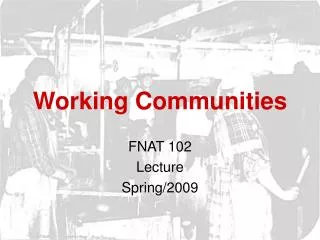
Working Communities FNAT 102 Lecture Spring/2009
‘Indians at Work’ • Knight (1978, 1996), a labour historian, paints a picture of the breadth of our peoples’ work lives and contributions in B.C.’s early history • Farming, mining, on the railways, freight transporting, as seamen & riverboat crew, long shoring, as entrepreneurs, logging, in sawmills, fishing, canning, as entertainers and artisans for the ethnographic trade. • Particularly interested in labour/union activity • Left academia in 1977 after stints at U of T, SFU and Manitoba
Countering Merivale and other mythmakers • Often our people portrayed as needing ‘protection’ and ‘unable to compete’ • We were the workforce of early B.C. as Boas noted (Lutz, 1992) • The settlers are often portrayed as self-reliant ‘pioneers’, who carved the province out of a backward wilderness • The success of our enterprise and the need to discriminate against our full participation counters the former • The breadth and depth of our labours and their significance to the early economy counters the latter
First Nations and the Foundation of the B.C. Fishery • In the late 19th century most of the suppliers and cannery workers were First Nations people • Early identification or potential and success due to traditional knowledge of where and when to fish • Huge growth with our participation but that success lives little room for work for settlers and immigrants • Dominion government started to regulate the fishery, confine FN to a ‘food fishery’, & discriminate in licensing • Barricade Act (1905) attacks traditional technologies (King, 2004)
Life in the Canneries • ‘I know, many [Stó:lo] families that stayed there years and years, until finally the canneries were phased out or stopped canning the fish here in the lower mainland” (Woods,1998) • Often seasonal wage employment, with men on the boats and women & children living at the canneries
Activity in the Commercial Fishery • 1900 on the Fraser alone 555 gillnet licenses plus additional cannery licenses (p. 185) • Decline in numbers through mid-century regulations and discrimination • In 2003 owned 564 vessels out of a total fleet of 2885 • 26.9% of all commercial licenses • Varies from fishery to fishery • Spawn-on-kelp 80% • Salmon 30% • Continued resistance to aboriginal participation e.g. B.C. Fisheries Survival Coalition Teakerne Resource Consultants (2004)
Freshwater follows the pattern • Manitoba example (Tough,1996) • Late 1800’s a booming whitefish and sturgeon fishery on lakes Winnipeg and Manitoba • Source of affluence for aboriginal people in a ‘common property’ fishery • Increased conflict over the resource led to regulations (under terms of Treaty 5) • Slowly decreased number of areas where aboriginal people could fish • Declining role except as food fishery & local sales though closure of the fishery in the 1960’s
Forestry: Logging, Mills & Long shoring • Primary source of income listed in 1876 Indian Affairs report for B.C. • Formed significant membership of the industry unions by the 1920’s • Sawmills in Puget Sound employed hundreds (Lutz, 1992) • 1881 Indian Commisioner remarked that “indian workers were preferred to whites” • During and after the depression more marginalized and displaced in the workforce
Skxwúmish Longshoreman (Parnaby, 2006) • Gravitated to Burrard Inlet in large numbers; figured heavily in B.C.’s industrialization • Organized in ‘gangs’ specializing in loading/unloading logs & lumber • ‘They were the greatest men that ever worked the lumber’( ILWU Pensioners, 1986) • Effectively protested harsh working conditions (Bows & Arrows local of IWW) • Many blacklisted after the 1923 strike…ILA membership goes from “mostly Indians” to “many who had not worked on the waterfront , within six weeks”
Farmers • Many prairie treaties included provisions for agricultural implements and instruction in farming • The book Lost Harvestsdetails howas success increased government began to deny access to machinery and stock (Carter,1991) • Denied right to sell their surplus • Parallel to a food fishery & ban on commercial sale • Assigned role as migrant workers for hops and other picked crops
Playing to the Primitive • Communities create economy where they are ‘allowed’ to participate • Anthropologists and others interest in pre-contact and primitive • A rush to collect and ‘preserve’ • Museums, private collectors and tourists • Began iconic association with Canadian wilderness travel and tours
Cashingin on the Curio factor • Flood of collectors 1890-1920 • Later crash in demand (except for cheap, mass produced souvenirs) until art resurgence of the 1970’s • Interested in the colourful and ‘exotic’ • Communities began to produce items solely for this market
Touring & Performing • Followed the lead of eastern & plains people e.g. Bella Coola 1880’s tour of Germany • World’s Fair appearances e.g. ‘Hamatsa’ performances at 1904 • ‘posing’ for ethnographic pictures e.g. Curtis’ pictures of traditional people (all working as loggers, seine boat captains, etc.)
Tourism and the Selling of Culture • 4 broad areas of potential conflict described by Robinson (1999) • As economy it has implications for community • Resurgence in our communities now/ especially remote or resource declining • Shift from performers to actual control • Issues of authenticity and authority abound
A Different Picture • One of opportunity denied rather than inability to compete • The myth of a superior culture needed a little help/ dispossession of property wasn’t enough • Current successes indicate what could have been • Remarkable achievements (seine boat captains, logging crew leaders, businesses, etc.) in communities regardless