SlideServe
Menu
Préférences
© SlideServe · v2026

Chapter 02 Continuous Wavelet Transform CWT

gail-fowler avatar
32 diapositives · 498 Views · Nov 08, 2014

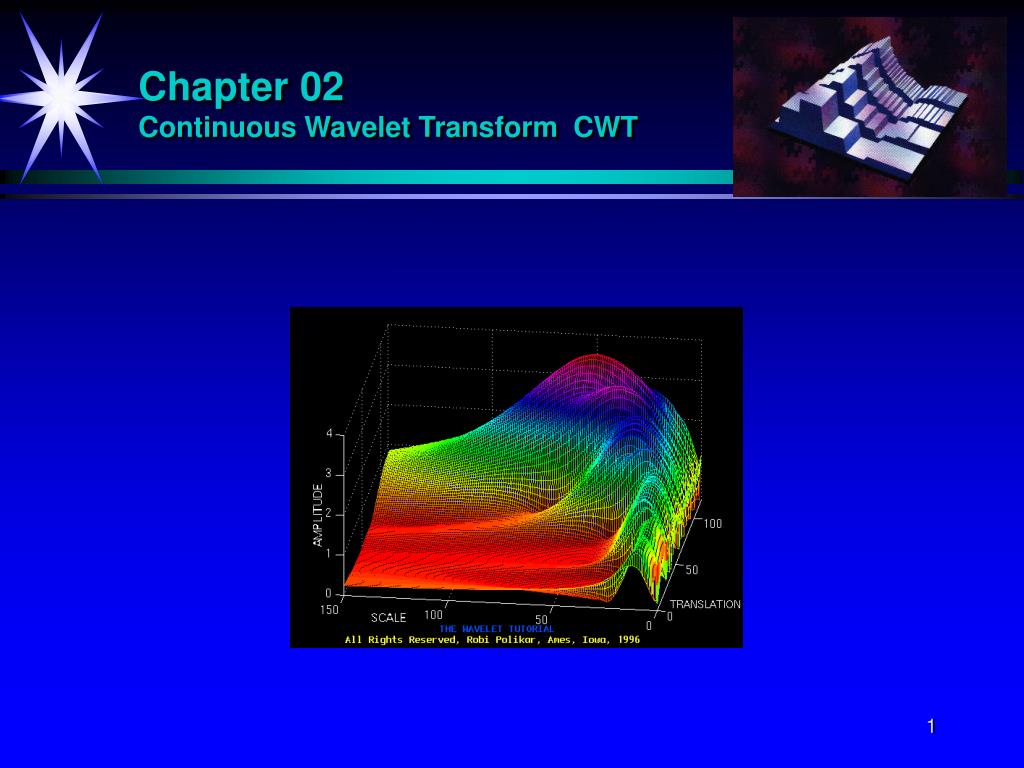
Chapter 02 Continuous Wavelet Transform CWT. Definition of the CWT. The continuous-time wavelet transform (CWT) of f(t) with respect to a wavelet (t):. Mother Wavelet Dilation / Translation.  Mother Wavelet s Dilation Scale  Translation. Definition of a mother Wavelet (or Wavelet).
Chapter 02 Continuous Wavelet Transform CWT - slide 1
01 / 32Chapter 02 Continuous Wavelet Transform CWT
1 / 17

Télécharger la présentation

Chapter 02 Continuous Wavelet Transform CWT
Une image / un lien ci-dessous est fourni (tel quel) pour télécharger la présentation

Politique de téléchargement : le contenu du site vous est fourni TEL QUEL pour votre information et votre usage personnel ; il ne peut être vendu, concédé sous licence ni partagé sur d’autres sites sans l’accord de son auteur.Le contenu vous est fourni TEL QUEL, pour votre information et votre usage personnel uniquement. Téléchargez la présentation en cliquant sur ce lien. Lors du téléchargement, si vous ne parvenez pas à télécharger une présentation, l’éditeur a peut-être supprimé le fichier de son serveur.Pendant le téléchargement, si vous ne parvenez pas à obtenir une présentation, le fichier a peut-être été supprimé par l’éditeur.

F I N

Plus de contenu associé

Transcription de la présentation
  1. Chapter 02Continuous Wavelet Transform CWT

  2. Definition of the CWT The continuous-time wavelet transform (CWT) of f(t) with respect to a wavelet (t):

  3. Mother WaveletDilation / Translation  Mother Wavelet s Dilation Scale  Translation

  4. Definition of a mother Wavelet (or Wavelet) A real or complex-value continuous-time function (t) satisfying the following properties, is called a Wavelet: 1. Wavelet 2. Finite energy 3. Admissibility condition. Sufficient, but not a necessary condition to obtain the inverse.

  5. The Haar Wavelet and The Morlet Wavelet Haar Morlet 1 1 -1

  6. Forward / Inverse Transform Forward Inverse  Mother Wavelet s Dilation Scale  Translation

  7. Admissibility condition It can be shown that square integrable functions (t) satisfying the admissibility condition can be used to first analyze and then reconstruct a signal without loss of information. Admissibility condition. Sufficient, but not a necessary condition to obtain the inverse. The admissibility condition implies that the Fourier transform of (t) vanishes at the zero frequency. Wavelets must have a band-pass like spectrum. A zero at the zero frequency also means that the average value of the wavelet in the time domain must be zero. (t) must be oscillatory, it must be a wave.

  8. Regularity conditions - Vanishing moments The time-bandwidth product of the wavelet transform is the square of the input signal. For most practical applications this is not a desirable property. Therefor one imposes some additional conditions on the wavelet functions in order to make the wavelet transform decrease quickly with decreasing scale s. These are the regularity conditions and they state that the wavelet function should have some smoothness and concentration in both time and frequency domains. Taylor series at t = 0 until order n (let  = 0 for simplicity): pth moment of the wavelet Moments up to Mn is zero implies that the coefficients of W(s,t) will decay as fast as sn+2 for a smooth signal. Oscillation + fast decay = Wave + let = Wavelet

  9. Dilation / Translation: Haar Wavelet Haar 1 1 1 2-1/2 2-1/2 1 4 2 4 4 2 -1 -1 -1

  10. Dilation / Translation: Morlet Wavelet Morlet

  11. CWT - Correlation 1 Cross- correlation CWT CWT W(s,) is the cross-correlation at lag (shift)  between f(t) and the wavelet dilated to scale factor s.

  12. CWT - Correlation 2 W(a,b) always exists The global maximum of |W(a,b)| occurs if there is a pair of values (a,b) for which ab(t) = f(t). Even if this equality does not exists, the global maximum of the real part of W2(a,b) provides a measure of the fit between f(t) and the corresponding ab(t) (se next page).

  13. CWT - Correlation 3 The global maximum of the real part of W2(a,b) provides a measure of the fit between f(t) and the corresponding ab(t) ab(t) closest to f(t) for that value of pair (a,b) for which Re[W(a,b)] is a maximum. -ab(t) closest to f(t) for that value of pair (a,b) for which Re[W(a,b)] is a minimum.

  14. CWT - Localization both in time and frequency The CWT offers time and frequency selectivity; that is, it is able to localize events both in time and in frequency. Time: The segment of f(t) that influences the value of W(a,b) for any (a,b) is that stretch of f(t) that coinsides with the interval over which ab(t) has the bulk of its energy. This windowing effect results in the time selectivity of the CWT. Frequency: The frequency selectivity of the CWT is explained using its interpretation as a collection of linear, time-invariant filters with impulse responses that are dilations of the mother wavelet reflected about the time axis (se next page).

  15. CWT - Frequency - Filter interpretation Convolution CWT CWT is the output of a filter with impulse response *ab(-b) and input f(b). We have a continuum of filters parameterized by the scale factor a.

  16. CWT - Time and frequency localization 1 Time Center of mother wavelet Frequency Center of the Fourier transform of mother wavelet

  17. CWT - Time and frequency localization 2 Time Frequency Time-bandwidth product is a constant

  18. CWT - Time and frequency localization 3 Time Frequency Small a: CWT resolve events closely spaced in time. Large a: CWT resolve events closely spaced in frequency. CWT provides better frequency resolution in the lower end of the frequency spectrum. Wavelet tool a natural tool in the analysis of signals in which rapidly varying high-frequency components are superimposed on slowly varying low-frequency components (seismic signals, music compositions, …).

  19. CWT - Time and frequency localization 4  a=1/2 a=1 a=2 t Time-frequency cells for a,b(t) shown for varied a and fixed b.

  20. Basis-funksjoner for Hilbert rommet L2(0,2).Fourier transformasjon. Fourier-serie Ortonormale basis-funksjoner Dilation Generering

  21. Basis-funksjoner for Hilbert rommet L2(R).Wavelet transformasjon. Wavelet-serie Ortonormale basis-funksjoner Dilation, translation Generering

  22. Fourier transformertav Wavelet funksjon Bevis:

  23. C - Teorem

  24. Teorem Bevis Benytter følgende notasjon:

  25. Teorem Bevis Benytter følgende notasjon:

  26. Binary dilation / Dyadic translation Binary dilation Dyadic translation

  27. Filtering / Compression Data compression Remove low W-values Highpass-filtering Lowpass-filtering Replace W-values by 0 for high a-values Replace W-values by 0 for low a-values

  28. Inverse Wavelet transformation 1 WT Dual IWT = WT-1 Modifisert

  29. Inverse Wavelet transformation 2 a,b  R WT Condition  Basic Wavelet Inverse Dual

  30. Inverse Wavelet transformation 3 a,b  Ra > 0 WT Condition Inverse Dual

  31. Inverse Wavelet transformation 4 a,b  Ra = 1/2j WT Condition  Dyadic Wavelet Inverse Dual

  32. End