Understanding Ligaments: Functions, Injuries, and Assessment of Joint Stability
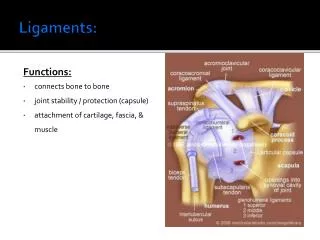
Ligaments play a crucial role in connecting bone to bone, providing joint stability and protection through their encapsulating structure. They also allow for the attachment of cartilage, fascia, and muscle. Common injuries, such as ACL tears and lateral ankle sprains, highlight their importance. The end feel of joint movement can be assessed subjectively, indicating normal or abnormal range of motion (ROM) based on factors like pain, inflammation, or soft tissue injury. Understanding the characteristics of end feel, such as "hard," "firm," or "empty," allows for better evaluation of joint health.

Understanding Ligaments: Functions, Injuries, and Assessment of Joint Stability
E N D
Presentation Transcript
Ligaments: Functions: • connects bone to bone • joint stability / protection (capsule) • attachment of cartilage, fascia, & muscle
End Feel (Lippert Ch. 4) • subjective • assessed at the end of passive ROM of a joint Limitations to ROM: ‘Normal ‘ - ligaments - muscle - bone / soft tissue approximation ‘ Abnormal’ - pain - inflammation / edema - injured muscle, tendon, lig. - fracture
End Feel cont’d. Descriptors: • “Hard / Bony” * bone contacting bone Ex. Elbow extension • “ Firm / Capsular” *slight ‘give’ at end ROM Ex. Shoulder flexion • “ Empty” * unable to attain end of ROM due to pain or disruption of soft tissue