Photosynthesis & respiration
50 likes | 145 Vues
Learn about photosynthesis, a process that converts solar energy into chemical energy, allowing plants to produce their food. Understand ATP, the common energy currency of cells, and the structure of chloroplasts, where photosynthesis occurs.


Photosynthesis & respiration
E N D
Presentation Transcript
Photosynthesis & respiration Intro to Photosynthesis
ATP (adenosine triphosphate) • The common energy currency of cells • When cells require energy, they “spend” ATP • Can be used for 3 types of work • Chemical work • ATP is used to synthesize macromolecules • Transport work • ATP is used to pump substances across the plasma membrane • Mechanical work • ATP is used to contract muscles, move cilia & flagella, and allows chromosomes to move • Generated from ADP (adenosine di-phosphate) • Structure • Composed of nitrogen base adenine, a ribose sugar, and three phosphate groups Target #1- I can describe ATP
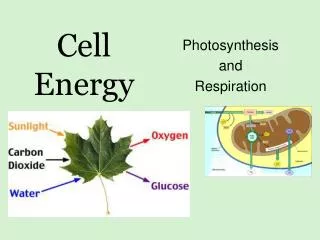
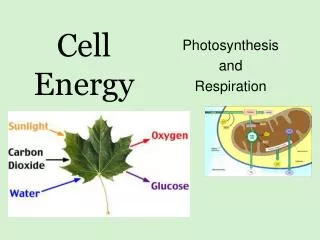
Photosynthesis: a process that converts solar energy into chemical energy • All plants produce their own food in the form of glucose • Pigments allow photosynthetic organisms to capture solar energy • Green plants use chlorophyll • Non-green plants use carotenoids • Raw materials used water and carbon dioxide Target #2- I can describe photosynthesis
Target #3- I can write the equation for photosynthesisTarget #4- I can identify the reactants & products of photosynthesis
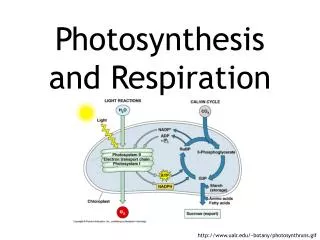
The roots of plants absorb water • Moves up the stem and to the leaves through veins • Carbon Dioxide in the air enters the leaves through small openings called stomata • Double membrane surrounds the chloroplast • Contains a fluid center called stroma • Contains stacks called grana made of discs called thylakoids • Pigments like chlorophyll are found in the thylakoid membranes Target #5- I can describe the parts of a chloroplast associated with photosyntheis