Comprehensive Overview of the Axial Skeleton: Bones, Features, and Functions
160 likes | 276 Vues
This lab review focuses on the axial skeleton, including the vertebral column and thoracic cage. Explore the distinctive features of cervical, thoracic, lumbar vertebrae, and their articulations, as well as the rib structure and the thoracic cage. The guide also highlights the significance of the skull and hyoid bone, providing a thorough understanding of the bones in the adult skeletal system. Key terms related to joints and vertebrae are described to enhance your 3D comprehension of the axial skeleton. Remember to handle all bones with care!


Comprehensive Overview of the Axial Skeleton: Bones, Features, and Functions
E N D
Presentation Transcript
Unit 2: Skeletal SystemLab 2: Axial Skeleton Jessica Radke-Snead, RD, MS Bio 241 Anatomy & Physiology
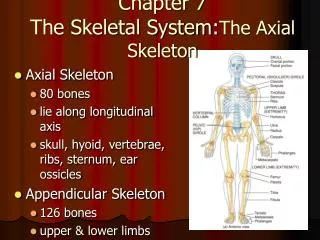
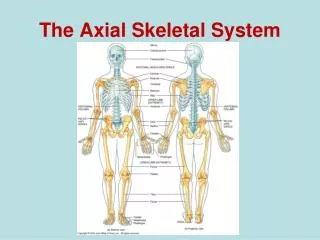
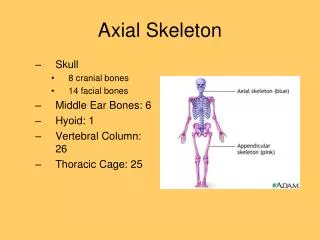
Review:Bones of the Adult Skeletal System • Appendicular skeleton (126) • LAB 3 • Pectoral girdle (4) • Upper limb (60) • Pelvic girdle (2) • Lower limb (60) • Axial skeleton (80) • LAB 1 • Skull (22) • Auditory ossicles (6) • Hyoid bone (1) • LAB 2 • Vertebral column (26) • Thoracic cage (25)
Cervical Vertebrae • Distinctive features • All have transverse foramen—protection for the vertebral arteries—that are NOT present in any other vertebrae • C1 (atlas) and C2 (axis) allow for head movement Axis is the only vertebrae with a dens; begins to form during the first year of life and fuses with the axis by the age of 3-6 years • C3-C6 have transverse foramina and bifid spinousprocesses • C7 is different—spinous process is not bifid, but especially long and forms the prominent bump on the lower back of the neck (vertebra prominens) • Atlanto-occipital joint: articulation between the atlas and the cranium • Atlanto-axial joint: articulation between the atlas and axis
Thoracic Vertebrae • Distinctive features • Lack transverse foramina and bifid processes • Spinous processes pointed and angle sharply downward • Include costal facets No other vertebrae have ribs articulating with them • T1-T10 have transverse costal facets at the end of each transverse process provides a second point of articulation for ribs 1-10 • T11 and T12 have NO transverse costal facets ribs 11 and 12 attach only to the bodies of vertebrae (“floating ribs”) • Inferior and superior costal facet: position on the vertebrae, not articulating rib • Superior and inferior articular facets: position on a vertebrae • T12 inferior articular facets face laterally instead of anteriorly positions them to articulate with the medially facing superior articular facets of the first lumbar vertebrae
Thoracic vertebrae: include: Rib facets: round fossa where ribs connect to the vertebrae or Demifacets:rib facet divided between 2 vertebraes
Lumbar Vertebrae • Distinctive features • Thick, stout body • Blunt, square-like spinous processes • Articular processes oriented differently: • Superior processes face medially • Inferior processes face laterally (toward the superior processes of the next vertebrae) resistant to twisting
Lumbar vertebrae lack: Rib facets and Transverse foramina
Sacrum • Consists of 5 vertebrae Fuses age 16-26 • Forms the posterior wall of the pelvic cavity
Coccyx • Consists of 4-5 small vertebrae Fuses age 20-30 • Serves as attachment points for muscles of the pelvic floor • Cornua: hornlike projections that serve at attachment points for ligaments that bind the coccyx to the sacrum
Thoracic Cage:Ribs • 12 pairs, no differences between genders • Attached at posterior (proximal) end to the vertebral column • Costal cartilage • Hyaline cartilage extends from the anterior (distal) ends of ribs 1-7 to the sternum “true ribs” • Ribs 8-10 attach to the costal cartilage of rib 7 – “false ribs” • Ribs 11-12 do not attach to anything at the distal end, but are embedded in muscle “false ribs”, “floating ribs”
Lab 2 Objectives • Identify and describe the bones and features of the vertebral column and thoracic bones designated in your lab • Observe these structures from multiple viewpoints to develop a 3D comprehension • Review the bones and features of the skull (adult and fetal) designated in lab 1 • Put together a comprehensive understanding of the axial skeleton Please be careful with the bones—ask for assistance if needed! Enjoy!