Understanding the Female Reproductive System and Breast Health
230 likes | 351 Vues
This guide explores key components of the female reproductive system, including the ovaries, uterus, and menstrual cycle. It emphasizes the importance of breast self-examination as a monthly routine to monitor breast health and detect any changes like lumps or discharge. Additionally, it covers hormonal functions such as estrogen and progesterone, and other terms like menstruation, menopause, and ovulation. Knowledge of these topics is essential for maintaining reproductive health and understanding the body's changes throughout different life stages.


Understanding the Female Reproductive System and Breast Health
E N D
Presentation Transcript
Breast Self Exam • Is a cancer screening procedure in which a female visually examines her breasts, palpates them to detect any lumps, and squeezes her nipples to check for a clear or bloody discharge. • Breast self-examination should be done once a month to become familiar with the usual appearance and feel of your breasts. Most lumps are not cancerous, but any lump should be checked out by a doctor to make sure.
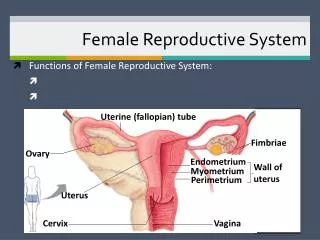
Cervix • The base of the uterus, which bulges down into the vagina. • Has a small opening through which sperm can enter the uterus.
cilia • Align the fallopian tubes and are responsible for pushing the egg through the fallopian tubes. • Movement of cilia move against sperm.
Clitoris • Is a small knob of erectile tissue in the front of the vaginal opening.
Corpus Luteum • Referred to as the yellow body. Is a temporary gland that secretes the hormones estrogen and progesterone, which cause the endometrium, the inner layer of the uterus, to thicken. • Where egg releases from the ovary. Releases hormones to prepare the uterus for the arrival of the egg
Estrogen • Is a hormone essential for normal female sexual development and for the healthy functioning of the reproductive system. • Estrogen controls the development and maintenance of female secondary sex characteristics and reproductive organs, and the menstrual cycle.
Fallopian Tube • Is a three to five inch tube that carries the egg to the uterus from the ovaries.
FSH • Follicle Stimulating Hormone. Is a hormone that telegraphs the message from the brain to the gonads to start producing sex cells and sex hormones. Occurs during puberty
Graafian Follicle • Is the egg that matures and bursts out first. • All of the other potential eggs degenerate.
LH (Luteinizing Hormone) • In females, helps to create a duct work system in the breasts for breast feeding. • Is the other hormone, other than FSH, to be produced by the pituitary gland.
Menarche • Is the first menstrual cycle. • Usually, the menstrual cycle occurs in regular phases.
Menopause • Is the cessation of the monthly menstrual cycle pattern. • It usually occurs somewhere between the ages of forty-eight and fifty-two.
Menstruation • Is the process by which the lining of the uterus is expelled each month that pregnancy does not occur.
Ovary (Gonad) • Female reproductive gland • Place where egg cells develop. • Secretes hormones
Ovulation • Releasing of a mature ovum (egg) from an ovary • Begins journey down the Fallopian Tube (3-7 days)
Ovum (Ova) Another word for the egg
Pap Test (Smear) • Is a screening test for cervical cancer in which cells are scraped from the cervix and examined for abnormalities.
Progesterone • Along with estrogen, is the major female sex hormone. • These female sex hormones cause female changes at puberty.
Urethra • Tube which connects to the bladder for elimination of urine
Uterus (Womb) • Strongest muscle in the female body. • Hollow pear shaped organ where the baby grows.
Vagina • Tube from cervix to outside the body • Female reproductive structure that receives the sperm. • Passageway for menstrual flow
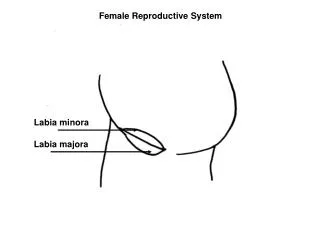
Vulva • The external female reproductive genitalia • Includes labia minora, labia majora, and clitoris