RC, RLC circuit and Magnetic field
130 likes | 285 Vues
This guide explores the fundamental concepts of RC and RLC circuits, including charge relaxation and oscillations. It delves into the behavior of capacitors during discharging, highlighting the exponential decay of charge and current defined by the time constant τ = RC. We also examine the dynamics of LC circuits exhibiting oscillatory behavior, the mathematical descriptions of charge over time, and the impact of resistance on oscillations. The Biot-Savart Law is introduced to understand magnetic fields generated by currents, particularly in configurations like Helmholtz coils.


RC, RLC circuit and Magnetic field
E N D
Presentation Transcript
RC, RLC circuit and Magnetic field RC Charge relaxation RLC Oscillation Helmholtz coils
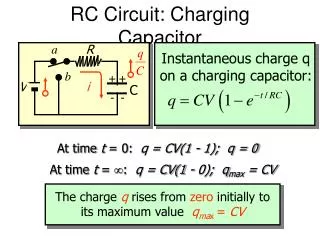
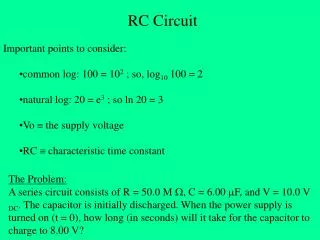
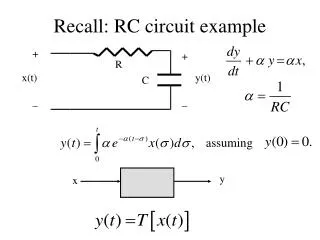
RC Circuit • The charge on the capacitor varies with time • q = Ce(1 – e-t/RC) = Q(1 – e-t/RC) • t is the time constant • = RC • The current can be found
Discharging Capacitor • At t = = RC, the charge decreases to 0.368 Qmax • In other words, in one time constant, the capacitor loses 63.2% of its initial charge • The current can be found • Both charge and current decay exponentially at a rate characterized by t = RC
Oscillations in an LC Circuit • A capacitor is connected to an inductor in an LC circuit • Assume the capacitor is initially charged and then the switch is closed • Assume no resistance and no energy losses to radiation
Time Functions of an LC Circuit • In an LC circuit, charge can be expressed as a function of time • Q = Qmax cos (ωt + φ) • This is for an ideal LC circuit • The angular frequency, ω, of the circuit depends on the inductance and the capacitance • It is the natural frequency of oscillation of the circuit
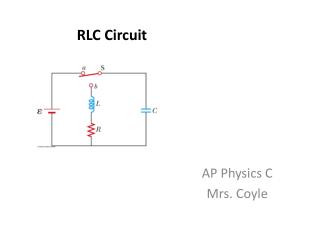
RLC Circuit A circuit containing a resistor, an inductor and a capacitor is called an RLC Circuit. Assume the resistor represents the total resistance of the circuit.
RLC Circuit Solution • When R is small: • The RLC circuit is analogous to light damping in a mechanical oscillator • Q = Qmaxe-Rt/2L cos ωdt • ωd is the angular frequency of oscillation for the circuit and
RLC Circuit Compared to Damped Oscillators • When R is very large, the oscillations damp out very rapidly • There is a critical value of R above which no oscillations occur • If R = RC, the circuit is said to be critically damped • When R > RC, the circuit is said to be overdamped
Biot-Savart Law • Biot and Savart conducted experiments on the force exerted by an electric current on a nearby magnet • They arrived at a mathematical expression that gives the magnetic field at some point in space due to a current
Biot-Savart Law – Equation • The magnetic field is dB at some point P • The length element is ds • The wire is carrying a steady current of I
B for a Circular Current Loop • The loop has a radius of R and carries a steady current of I • Find B at point P
Helmholtz Coils (two N turns coils) If each coil has N turns, the field is just N times larger. At x=R/2 B is uniform in the region midway between the coils.