Growth & Development
This overview outlines critical milestones in infant growth and development during the first year, emphasizing the distinctions between growth (quantitative changes) and development (qualitative changes). Key trends such as cephalocaudal and proximodistal directions in motor control are highlighted, along with the significance of sensitive periods. You will also encounter Erikson's trust vs. mistrust theory and Freud's oral stage, explaining how these psychological frameworks impact infant behavior and personality. Understanding these stages aids parents and caregivers in fostering healthy development.

Growth & Development
E N D
Presentation Transcript
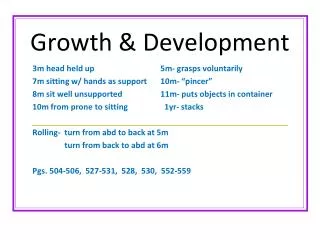
Growth & Development 3m head held up 5m- grasps voluntarily 7m sitting w/ hands as support 10m- “pincer” 8m sit well unsupported 11m- puts objects in container 10m from prone to sitting 1yr- stacks Rolling- turn from abd to back at 5m turn from back to abd at 6m Pgs. 504-506, 527-531, 528, 530, 552-559
Growthquantitative change • Occurs in spurts • Examples (measurable) • Height • Weight • Number of teeth • Bone density
Developmentqualitative change • Combination of growth, maturation, and learning • Simple to complex (ex: learning to write… scribble -> write -> cursive) • Generally, measured by observation
Directional trends • Bilateral and symmetrical (growth at same rate/time) • Cephalocaudal(cephalo- head, caudal- tail) • Head-to-tail • Motor control over head before trunk and extremities • Proximodistal(proxim- near, distal- far) • Near-to-far (control of center first) • Motor control over arm before fingers (palm to fingers)
1 month- just floppin’ around Cephalocaudaldevelopment Know age for basic motor skills. (roll, crawl, sit-up) 3 months- needs help 8 months Mosby, 2001
Sequential trend “In-order trend” • Predictable sequence Crawl 6-9m ▼ Stand ▼ Walk
Developmental pace • Each child grows at their own pace • Body systems develop at different rates • Alveoli continue to bud until 8-years-of-age • Females mature faster than males
Sensitive period • Periods in life when the person is more susceptible to positive or negative influences • Example • Normal development of the central nervous system requires adequate nutrition during the first two years of life (adequate amount of fat/nutirtion req’d)
Infant Birth – 1 year Trust vs mistrust- Erickson Oral stage- Fraud Sensorimotor period- Piaget
Appearance • 1 – 6 months • 1 ½ pounds per months • 6 months • Double birth weight • 12 months • Triple birth weight
Psychosocial theoryerikson Emphasizes a healthy personality Key conflicts during critical periods in personality development Have to complete one to move on to the next.
Task of infancy • “The main task of infancy is to acquire a favorable ratio of trust to mistrust” (miller, pg 161) • Trust is “the sense that there is some correspondence between your needs and your world.” (Miller, pg 161)
Trust versus mistrust • Crucial elements • Quality of the parent – child relationship • Care the infant receives • If trust wins, then that child has a sense of security that’ll help them onto the next stage. • If mistrust wins, then they will not develop that sense of trust. (Fear, frustration, no confidence)
Characteristics • Narcissism • A degree of egocentrism • Total concern for self • Transitional object • Aka security object- child will keep it close for comfort (blanket)
Psychosexual theoryFreud Regions of the body assume psychological significance as A source of pleasure
Oral stage • Age • Birth – 1 year • Source of pleasure seeking • Oral activities • Sucking, biting, chewing, vocalizing
Nonnutritive sucking • Not satisfied by feeding, the baby’s need to suck on something. Sometimes a new parent will see this and mistake it for hunger. • Pacifier • Sturdy, one-piece construction is best • Handle • Two ventilating holes • No detachable ribbon or string
Make sure you get a pacifier cannot be pulled into parts. Also do not attach pacifier with a string/line else risk for strangulation. Mosby 2001
Thumbsucking • Most stop by 4- to 5-years-of-age • Malocclusionmay occur if persists beyond 5 • Abnormal contact of opposing teeth that negatively affects chewing “bad closing” • Social consequences for the school-age child who sucks their thumb
Definitions- what infant does when they meet a new challenge • Assimilation- taking current skills and applying them to new situations. • Interpreting new experiences in terms of existing ideas or skills • Accommodation- adapt behavior to a new situation • Previous experience is modified to explain a current situation • From punching girls to opening doors.
Sensorimotor period • Birth – 24 months • Six sub-stages • Development of intellect and knowledge of environment gained through the senses • Behavior pattern Reflexive to repetitive to imitation
Modification of reflexes(sensorimotor period) 1stsubstage • Birth – 1 month • Think of baby as a “bundle of reflexes”- their behavior is a reflex. • Stop crying once food hits stomach.
Definitions • Circular reaction • Action that is repeated over and over • Often viewed as pleasurable by infant • Primary • Centered on or around the infant’s body • Secondary • Orientation to the environment • Interest in sounds/environment
Primary circular reactions 2ndsubstage • 1 – 4 months • Centered around body • Beginning to replace reflexive behavior with voluntary action (ex: mom’s voice -> food is on the way) • A rattle is a good toy
Secondary circular reactions 3rdsubstage • 4 – 8 months • Greater awareness of the environment • About 6 months-of-age • Imitation • Increased affect (this helps family bond w/ baby. More emotion: laugh, interaction) Erikson’s trust vs mistrust • Object permanence(baby looks for things they cannot see) ex: a dropped ball, peek-a-boo
Coordination of secondary schemes 4thsubstage • 8 – 12 months • Planning emerges-getting toy from far away • Anticipation of events- • baby only sees peas and they right away clamp their mouth. • Or they know when you’re about to leave when you pick up the keys.
Separation anxiety&stranger anxiety Important component of A strong, healthy parent-child attachment
Theory & separation anxiety • 4 – 8 months • Begin to have some awareness of self and mother as separate beings • As object permanence develops the infant becomes aware the parent can be absent ▼ Separation anxiety
Behavior & separation anxiety- a normal behavior • An infant may cry, scream, search for parents with eyes, clings to parent, avoid and reject contact with strangers • Protest when placed in crib • Protest when mother leaves the room • May not notice the mother has left if absorbed in an activity ▼ When the infant realizes the mother is gone, protest (new person will want to extend hand first to develop trust)
Stranger anxiety • 6 – 9 months • Reemerges during toddler period • Related to infant’s ability to discriminate between familiar and non-familiar people • As the infant becomes attached to one person, they show less friendliness to others
What to do • Talk softly • Meet the child at eye level • Maintain a safe distance • Avoid sudden intrusive gestures • Reassure parents • Healthy behavior • Reassurance • Use transitional objects (ex: encourage child to talk to stuffed animal)
Overview • Baby teeth, deciduous “falling off” teeth, primary teeth • Purpose • Baby teeth protect dental arch, thus paving the way for the permanent teeth. • Play a role in • Growth & development of the jaw and face • Speech development • If lost early the remaining teeth may • Drift out of position • Block eruption of the permanent teeth
Overview • Baby teeth are prone to decay because of • Thin enamel • Short distance from tooth surface to pulp • Clean an infant’s teeth with a damp cloth • No toothpaste, cause the baby will swallow it and the fluoride can be harmful
Early childhood caries “tooth disease” • This is where teeth have been bathed in carbohydrate rich solution • Prevention • Do not prop the bottle • Use pacifier for nonnutritive sucking • If nighttime bottle needed use water • Offer fruit juice from a cup
Teething • Rule of thumb: Age in months minus 6 months = # of teeth Ex: 9 months = about 3-4 teeth • Normal variation • 6 – 9 months • Genetic pattern
Teething order • Lower central incisors • Upper central incisors • Upper lateral incisors • Lower lateral incisors • Not sure if the discomfort is from teething? • Gently press on gum where the tooth should erupt
Signs of teething • Night wakening • Daytime restlessness • Increase in nonnutritive sucking • Excessive drooling • Anorexia tendency • Fever, nausea, diarrhea (total body response) • but when it comes to BOARDs -> don’t rely on it
Help for teething infants • Rub out initial swelling to help eat better • Cool liquids, hard foods, teethers • OTC medications • Beware! Many topical numbing medications contain benzocaine(in lrg amounts can cause burns, follow instructions!) • Acetaminophen • Absolute relief comes with tooth eruption
Nutrition More than taking in food 4-6m- Okay to start solids 6m- Juice okay (don’t heat cause it’ll lose Vit C) Portions- 1tbs per yr of age
More than taking in food • “Feeding an infant is more than offering food.” Which theoretical stage or period supports the above statement? • Oral stage- Freud • Sensorimotor period- Piaget • Trust versus mistrust stage- Erickson
The first 6 months • On demand schedule • Allowed to establish own feeding schedule(no longer than 4hrs w/out eating) • Should be fed until satisfied • Easy temperament babies may need a more planned schedule • Breast milk • Optimal • Formula • Acceptable alternative
Types of formula • Milk based • Remember: breast milk or formula w/in 1st yr. Whole milk after 1st yr. No skim milk until the 2nd yr, because of reduced amount of fat. • Infants without special nutritional needs • Soy based • Infants with protein sensitivity or lactose intolerant • Specialized • Available for A wide variety of needs (ex: anti-diarrhea formula)
Other types of formula • Ready to feed • Most expensive • Concentrate • Risk for incorrect measurement • Water supply (add it! If no dilution will harm kidneys!) • Powder • Risk for incorrect measurement • Water supply
Mixing formula • Improper dilution may increase protein intake • Can place heavy work load on immature kidneys • Water • Bottled (good- stay away from fluoride for < 6m) • Tap water (will have fluoride) • Run cold water for ~2 minutes before mixing formula, especially in older homes (to get lead out) • Well water (will not have fluoride) • Test for microorganisms
The second 6 months • Ready for solid food? • 4 months is acceptable if the baby is hungry all the time • 6 months is optimal • Infant is physiologically ready to eat • In your reading: Basic Principles of feeding. • When/How to introduce foods? • Introduce food every 7 days to examine for allergies. • Baby cereal until 18m • Juice- no more than 4oz/day • Rice best b/c of no allergies • Stop iron suppl when cereal is given • Microwave only fridge form. Heat only 4oz or more • 4oz = 30 sec and 8oz = 45sec Don’t shake, invert 10x • Formula/Breast Milk for 1yr, then whole milk
Iron supplement • During 3rd trimester unborn baby stores iron in its liver • Increased bioavailability of iron in human milk • Infants who are partially or not breastfed should receive iron fortified formula from birth to 12 months-of-age
Fluoride supplement • When & how • 6 months to 16 years • Usually in the community’s water supply • Fluorosis“excess fluorine discoloration and pitting of the enamel” • Too much fluoride will lead to brittle teeth/cavities
Language Language reflects hearing If you can’t hear then you won’t speak