Unit 3 - Photosynthesis
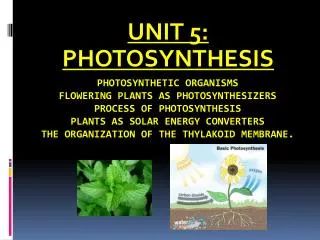
Photosynthesis is the biochemical process by which plants, algae, and some bacteria convert light energy into chemical energy. This essential process involves the conversion of carbon dioxide (CO2) and water (H2O) into glucose (C6H12O6) and oxygen (O2) using sunlight. The process occurs in two main stages: the light reactions, which take place in the thylakoids and involve electron transport and ATP formation; and the Calvin cycle in the stroma, which synthesizes carbohydrates. Key components include chlorophyll, photosystems, and the electron transport chain.

Unit 3 - Photosynthesis
E N D
Presentation Transcript
Unit 3 - Photosynthesis The Basis of Life
Overall Process 6CO2 + 12H2O + Light Energy C6H12O6 + 6O2 + 6H2
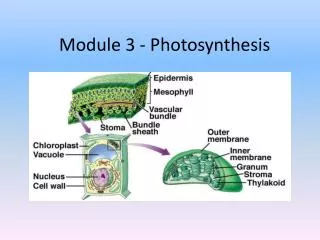
Structure of a Leaf • Stomata • Mesophyll
Chloroplast • Site of photosynthesis • Light Reaction – thylakoids • Calvin Cycle – stroma (fluid)
Redox in Biology • OIL – Oxidation Is Loss • RIG – Reduction Is Gain • In chemistry, “loss” or “gain” refers to e- • In biology, “loss” or “gain” refers to H atom • Ex: • NADPH is reduced (because it gained an H) • NADP+ is oxidized (because it lost the H)
Phosphorylation • Accomplished by enzymes called kinases • Attach a phosphate group (PO4) to a molecule • Makes molecule less stable due to increase in free energy (more ordered)
Two stages: • Light Rxn: • Reactants – Light (photons) and H2O • Products – O2, ATP, and NADPH • Calvin Cycle: • Reactants – ATP, NADPH, and CO2 • Products – CH2O (sugar!), ADP + Pi, NADP+
Light Rxn is divided into 2 parts • Photosystem II • Photosystem I • Photosystem – reaction center located on thylakoid membrane • Contain many light-harvesting complexes (contain chlorophyll)
Photosystem II (PSII) • Light, in the form of photons, hits leaf and is absorbed by chlorophyll (usually chlorophyll a) in PSII rxn center • e- with chlorophyll a gets excited and moves to higher energy state (gains PE) • @ same time, enzymatic rxn splits H2O 2e-, 2H+, and ½ O2 • e-’s from splitting of water (photolysis) replace e- that was excited in chlorophyll a
4. Electron Transport Chain (ETC) – e- is passed from PSII to PSI via a series of molecules • Each “pass” results in e- falling to a lower energy state • Exergonic processprovides energy to pump H+ (protons) into the thylakoid space.
Chemiosmosis • Light rxn creates a proton gradient due to ETC • Results in a pH, charge, and [] gradient • ATP Synthase– couples the diffusion of H+ ions back down their concentration gradient to stroma with phosphorylation of ADP to make ATP
pH gradient Concentration gradient Charge gradient
Photosystem I (PSI) • Light energy transfers from PSII PSI which excites e- • e- travels through PSI and enters another ETC • As e- travels down ETC, the exergonic process produces energy to convert NADP+ to NADPH (reduction!). • NADPH is the final electron acceptor!
Thus…. • Light rxns convert light energy to chemical energy stored in NADPH (@PSI) and ATP (via chemiosmosis). • Light rxns also produce O2 (@PSII) as a by-product.
Calvin Cycle (aka dark rxns aka light-independent rxns) • ATP and NADPH from light reactions provide energy to drive carbohydrate synthesis. • CO2 (from air) is reduced and “fixed” into carbohydrate • NADPH and ATP provide reducing power • Anabolic due to building up of sugar from smaller molecules and consumption of energy
Fates/uses of glucose • Provides plant with chemical energy and carbon (for synthesis of all organic macromolecules) • Proteins, lipids, nucleic acids • STARCH and CELLULOSE • Heterotrophs (us) consume autotrophs (plants)
Evolutionary background • Photosynthesis first evolved in prokaryotes • Evidence supports that prokaryotic photosynthesis was responsible for production of oxygenated atmosphere • Big point – prokaryotic photosynthetic pathways were foundation of eukaryotic photosynthesis