Download
1 / 11
110 likes | 251 Vues
Explore the nuanced meanings of key terms related to order and authority in this vocabulary lesson. Discover how verbs like "to coordinate" emphasize working together, while nouns like "disorder" describe confusion and lack of arrangement. Learn about adjectives such as "inordinate" and "insubordinate," which reflect exceeding limits and refusal to follow authority. This lesson also covers the concepts of "ordain" and "ordinance," highlighting their implications in governance and religious contexts. Enhance your understanding of structured communication with these foundational terms.

E N D
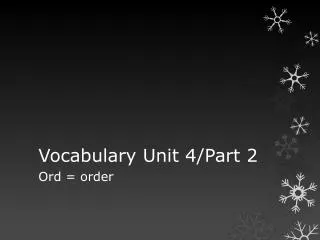
Vocabulary Unit 4/Part 2 Ord = order
Coordinate • Verb • To work together; to place in the same order, rank, or class
Disorder • Noun • Confusion; disarray; lack of regular order or arrangement
Inordinate • Adjective • Not regulated; disorderly; exceeding reasonable limits
Insubordinate • Adjective • Not submissive to authority; does not follow orders
Ordain • Verb • To authorize; to decree or enact; to order by virtue of superior authority, often in religious sectors
Orderly • Adjective • Adheres to a system; neat; systematically arranged
Ordinal • Adjective • Being of a specified position or order in a numbered series
Ordinance • Noun • An authoritative command or order
Subordinate • Adjective • Belonging to a lower rank or class; subject to the authority or control of another person; has to follow orders
Uncoordinated • Adjective • Lacking planning, method, or organization (Coordinated)