Understanding Exponential Functions: Characteristics and Graphs
Exponential functions are key mathematical concepts represented in the form y = ax, where a is a positive constant. This guide explores their properties, such as whether they are increasing or decreasing, whether they have maxima or minima, and their behavior at both ends. Specific examples like y = 2^x, y = 3^x, and y = 0.25^x illustrate different characteristics. The graph of an exponential function has unique shapes depending on the value of 'a', with the x-axis acting as an asymptote. Additionally, we discuss the natural exponential function e^x and its applications in compounding interest problems.

Understanding Exponential Functions: Characteristics and Graphs
E N D
Presentation Transcript
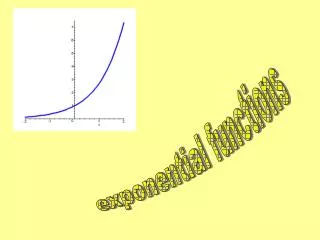
Introducing exponential functions What can you say about this function? Is it increasing or decreasing? y Does it have a constant rate? x Does it have any maxima or minima? How does it behave at either end? How do you think this function is written?
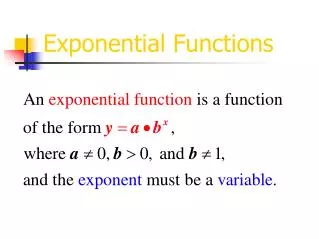
Exponential functions An exponential function is a function in the form: where a is a positive constant. y= ax Here are examples of three exponential functions: y = 2x y = 3x y = 0.25x In each of these examples, the x-axis forms an asymptote.
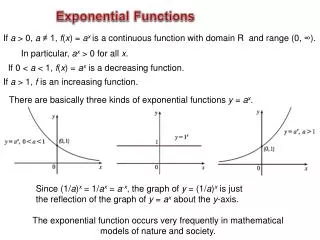
Summary of graphs When 0 < a < 1, the graph of y = ax has the following shape: y (1, a) (1, a) x The general form of an exponential function base a is: f(x) = ax where a > 0 and a≠1 When a > 1, the graph of y = ax has the following shape: y 1 1 x In both cases the graph passes through (0, 1) and (1, a). Why does this happen?
The number e This number denoted by e is an irrational number. e = 2.718281828459045235… (to 19 significant digits) Most scientific calculators have ex as a secondary function above the key marked “ln”. The function ex is called the exponential function or the natural exponential. This is not to be confused with an exponential function, which is any expression of the general form ax, where a is a constant.