Understanding Exponential Functions: Growth, Decay, and Properties of Powers
This guide explores the concepts of exponential functions, including growth and decay. It covers the properties of powers, such as addition and subtraction of exponents, and how to handle monomials and fractions. Key examples illustrate domain and range, roots of equations, half-life calculations, and population growth over time. Additionally, it demonstrates how the constant 'e' is involved in continuous compounding of interest. Practice problems help reinforce these concepts, equipping you with tools to analyze real-life exponential scenarios effectively.


Understanding Exponential Functions: Growth, Decay, and Properties of Powers
E N D
Presentation Transcript
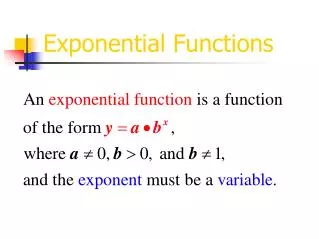
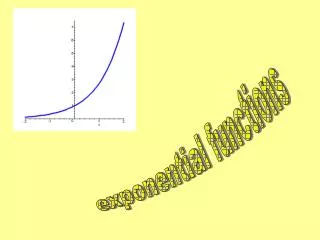
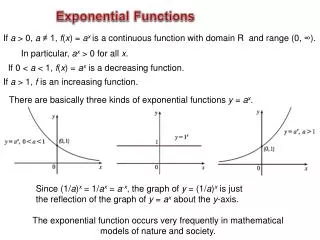
Exponential Function f(x) = ax for any positive number a other than one.
Examples • What are the domain and range of y = 2(3x) – 4? • What are the roots of 0 =5 – 2.5x?
Properties of Powers (Review) • When multiplying like bases, add exponents. ax● ay = ax+y • When dividing like bases, subtract exponents. • When raising a power to a power, multiply exponents. • (ax)y=axy
Properties of Powers (Review) • When you have a monomial or a fraction raised to a power (with no add. or sub.), raise everything to that power. or
Half-Life & Exponential Growth/Decay • The half-life of a substance is the time it takes for half of a substance to exist. • Mirrors the behavior of Exponential Growth & Decay functions. • Exponential Growth:y = kax, if a > 1 • k is the initial amount present • a is the rate at which the amount is growing • Exponential Decay:y = kax, 0 < a < 1 • k is the initial amount present • a is the rate at which the amount is growing
Example • Suppose the half-life of a certain radioactive substance is 20 days and that there are 5 grams present initially. When will there be only 1 gram of the substance remaining? After 20 days: After 40 days: IN GENERAL: Models the mass of the substance after t days. Therefore, let graph, and find intersection. t ≈ 46.44 days
Exponential Growth/Decay Example: A population initially contains 56.5 grams of a substance. If it is increasing at a rate of 15% per week, approximately how many weeks will it take for the population to reach 281.4 grams?
Exponential Growth Example: How long will it take a population to triple if it is increasing at a rate of 2.75%?
ecan be approximated by: The Number e • Many real-life phenomena are best modeled using the number e • e ≈ 2.718281828 • Interest compounding continuously: • I = Pert, where P = initial investment, • r = interest rate (decimal) • t = time in years
Example Compounding Interest • A deposit of $2500 is made in an account that pays an annual interest rate of 5%. Find the balance in the account at the end of 5 years if the interest is compounded a.) quarterly b.) monthly c.) continuously
Suggested HW • Sec. 1.3 (#5, 7, 11, 19, 21-31 odd) • 1.3 Web Assign Due Monday night