PFA Progress and Priorities
This talk by Mark Thomson discusses the latest advancements in Particle Flow Algorithms (PFA) and sets priorities for the upcoming Vienna ECFA meeting. It covers significant progress made at Snowmass, personal insights on PFA optimization, and introduces essential software tools like Mokka, MARLIN, LCIO, and SLIC that are crucial for detector optimization. Thomson presents a prioritized list of factors affecting PFA, emphasizing the need for organized collaboration and realistic goals to drive efficient research and development in the field of particle physics.

PFA Progress and Priorities
E N D
Presentation Transcript
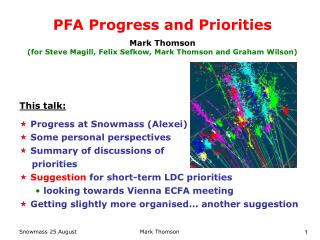
PFA Progress and Priorities Mark Thomson (for Steve Magill, Felix Sefkow, Mark Thomson and Graham Wilson) This talk: • Progress at Snowmass (Alexei) • Some personal perspectives • Summary of discussions of priorities • Suggestion for short-term LDC priorities • looking towards Vienna ECFA meeting • Getting slightly more organised... another suggestion Mark Thomson
Personal Perspective • Until recently we did not have the software tools to optimise the detector from the point of view of Particle Flow • This has changed ! • The basic tools are mostly there: • Mokka : now has scalable geometry for the LDC detector • MARLIN: provides a nice (and simple) reconstruction framework • LCIO: provides a common format for worldwide PFA studies • SLIC: provides a G4 simulation framework to investigate other detector concepts (not just GLD, LDC and SiD) • Algorithms: in MARLIN framework already have ALGORITHMS for TPC tracking, clustering + PFA We are now in the position to start to learn how to optimise the detector for PFA Some Caution: • This optimisation needs care: can’t reach strong conclusions on the basis of a single algorithm • A lot of work to be done on algorithms + PFA studies • Not much time : aim to provide input to the detector outline Need to get a little more organised + get more people involved Mark Thomson
Prioritised PFA list (from discussions + LDC, GLD, SiD joint meeting) The A-List (in some order of priority) • B-field : is BR2 the correct performance measure (probably not) • ECAL radius • TPC length • Tracking efficiency • How much HCAL – how many interactions lengths 4, 5, 6… • Longitudinal segmentation – pattern recognition vs sampling • frequency for calorimetric performance • 7) Transverse segmentation • 8) Compactness/gap size • 9) HCAL absorber : Steel vs. W, Pb, U… • 10) Circular vs. Octagonal TPC (are the gaps important) • 11) HCAL outside coil – probably makes no sense but worth • demonstrating this (or otherwise) • 12) TPC endplate thickness and distance to ECAL • 13) Material in VTX – how does this impact PFA The B-List • Impact of dead material • Impact (positive and negative) of particle ID - (e.g. DIRC) • How important are conversions, V0s and kinks • 4) Ability to reconstruct primary vertex in z Mark Thomson
Goals for Vienna (OPEN FOR DISCUSSION) Longer-term goals: • Understand B, R and L dependence • Understand impact of transverse granularity and longitudinal segmentation BUT: • Vienna is only 2.5 months away • Be realistic – main thing is to get this effort underway General points: • performance metric : jet-energy resolution • Z at 91 GeV • W+W- at 1 TeV • Try and attach names to goals… Vienna goals ….. Mark Thomson
Goals for Vienna: • B-field dependence: • Requires realistic forward tracking (HIGH PRIORITY) – Who ? • Radial and length dependence: • Ideally with > 1 algorithm • Complete study of “perfect particle flow” • Try to better understand confusion term • Breakdown into matrix of charged-photon-neutral hadron • Study HCAL granularity vs depth • already started (AR) • how many interaction lengths really needed ? • ECAL granularity • how much ultra-high granularity really helps ? • granularity vs depth Mark Thomson
Getting (a little) more organised Proposal: • Arrange monthly PFA phone conferences • Forum for people form to present/discuss recent progress • Goal : realistic PFA optimisation studies for Bangalore (and beyond) • Try and involve all regions : need to study EACH detector performance with multiple algorithms • First xday of each month 1600-1800 (CET) • not ideal for all regions but probably the best compromise • If people are in agreement – will set up an email list immediately after Snowmass • We can make real and rapid progress on understanding what really drives PFA • Provide significant input into the overall optimisation of the ILC detector concepts Mark Thomson