Download
1 / 1
10 likes | 123 Vues
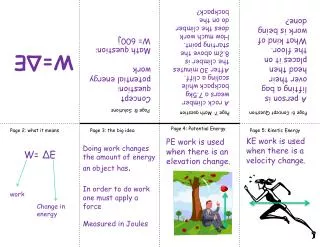
A rock climber ascends a cliff with a 7.5 kg backpack, reaching a height of 8.2 meters after 30 minutes. This scenario illustrates the concept of work done against gravity. We explore how to calculate the work done on the backpack using the formula W = ∆E. Additionally, we examine another scenario where a person lifts a bag, discussing the types of work involved. This guide covers concepts of potential energy, kinetic energy, and the relationship between force, work, and energy.

E N D
A rock climber wears a 7.5kg backpack while scaling a cliff. After 30 minutes the climber is 8.2m above the starting point. How much work does the climber do on the backpack? A person is lifting a bag over their head then places it on the floor. What kind of work is being done? Concept question: potential energy work Math question: W= 600j W=∆E Page 8: Solutions Page 7: Math question Page 6: Concept Question Page 4: Potential Energy Page 2: what it means Page 3: the big idea Page 5: Kinetic Energy KE work is used when there is a velocity change. PE work is used when there is an elevation change. Doing work changes the amount of energy an object has. In order to do work one must apply a force Measured in Joules W= ∆E work Change in energy