Unveiling the Diverse Kingdom Protista
Explore the classification and characteristics of the Protists kingdom, including animallike, plantlike, and funguslike protists. Learn about key phyla and their roles in ecosystems.

Unveiling the Diverse Kingdom Protista
E N D
Presentation Transcript
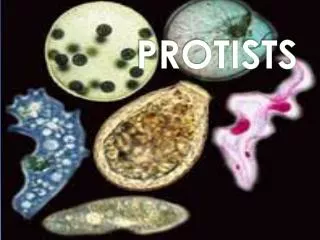
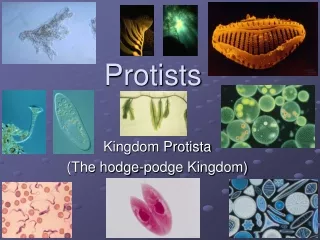
Protists Kingdom Protista (The hodge-podge Kingdom)
Section 20-1Kingdom Protista Protist = any organism that is not a plant, animal, fungus, or prokaryote - this kingdom is mostly unicellular, but includes many multicellular organisms as well - this kingdom will be broken into several kingdoms based on DNA analysis and other factors - similar to the first eukaryotes Classification of the Protists is based on Nutrition A) heterotrophic = animallike protists = protozoa B) autotrophic = plantlike protists C) decomposers/parasites = funguslike protists
Endosymbiont Hypothesis – Lynn Margulis - hypothesis that explains the evolution of the first eukaryotic cells from symbiotic prokaryotes
Animallike Protists = Protozoans - Unicellular heterotrophs - Four phyla based on locomotion: a. Zoomastigina – swim using flagella b. Sarcodina – move with pseudopodia c. Ciliophora – swim with cilia d. Sporozoa – no locomotion B. C. D. A.
Zoomastigina = Zooflagellates - most have one or two flagella - most absorb nutrients through cell membrane - often decomposers or parasites - reproduce primarily by mitosis - Trypanosomes – African Sleeping Sickness - Trichomonas vaginalis – most common protozoan infection in humans
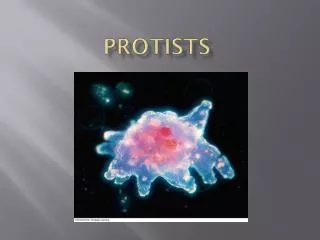
Phylum Sarcodina – Sarcodines - move and feed via pseudopods - temporary cytoplasmic extensions - ameboid movement - surround and engulf food into food vacuoles, digested nutrients are used, and undigested materials exit through the cell membrane - reproduce by mitosis and cytokinesis - Amoebas are best known examples - Foraminiferans - sarcodines of warm oceans with calcium carbonate shells - White Cliffs of Dover in England Heliozoans
Phylum Ciliophora – Ciliates - use cilia for locomotion and feeding - very fast swimmers - live in both fresh and salt water - most are free-living Internal Structures of Paramecium - trichocysts – small defensive structures - macronucleus – controls normal activities - micronucleus – reserve copy of genes; exchanged during conjugation - gullet – oral groove into which food enters - food vacuoles form around food and lysosomes fuse with it to digest food - wastes exit through anal pore - contractile vacuoles keep water balance
Paramecium Conjugation - normally paramecia reproduce by mitosis and cytokinesis - during stressful times they sometimes undergo conjugation - exchange micronuclei with each other - not reproduction because no new cells are formed, but it helps produce and maintain genetic diversity
Phylum Sporozoa – Sporozoans - do not move on their own - parasitic - often have complex life cycles with more than one host - reproduce by means of sporozoites Animallike Protists and Disease 1. Malaria - Plasmodium parasite kills up to 2 million people per year - Female Anopheles mosquitoes are the vector - mosquito’s saliva enters a person with sporozoites which get in person’s blood
- sporozoites enter liver and red blood cells - when erythrocytes burst it causes severe chills and fever - many strains of malaria have evolved resistance to the drugs we use against the parasites - best control is to control mosquitoes sporozoites sporozoites merozoites male gametophyte in erythrocyte
2. African Sleeping Sickness - Zooflagellate Trypanosoma - spread by Tsetse flies - damage the nervous system and can cause death 3. Amebic Dysentery - causes severe diarrhea and intestinal bleeding - Entamoeba - spreads by contaminated drinking water 4. Giardia - a flagellated protozoan that also causes diarrhea and digestive system problems Ecologically many protists are important decomposers and symbionts with other organisms - Trichonympha in termite guts digest cellulose
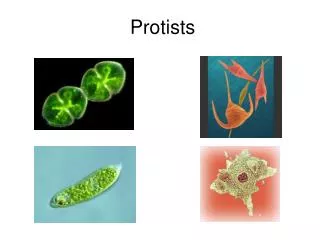
Sec. 20 -3 Plantlike Protists – Unicellular Algae - often classified based on the type of photosynthetic pigments they have - have many different pigments to absorb the light that can penetrate into deep water (blue) - have chlorophyll a, b, and c - accessory pigments absorb wavelengths that chlorophylls can’t Phylum Euglenophyta - have two flagella, but no cell walls - genus Euglena - found in lakes and ponds - eyespot allows them to swim toward light - can live autotrophically or heterotrophically
Phylum Chrysophyta – Yellow-green + golden-brown - means “golden plants” - cell walls of pectin rather than cellulose - golden algae often cause fish kills Lake Wichita Spring 2009
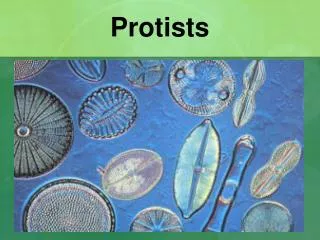
Phylum Bacillariophyta – Diatoms - make shells of silicon (glass) - shells of two parts like a petri dish
Phylum Pyrrophyta – Dinoflagellates - half are heterotrophic; half autotrophic - most have two flagella and a shell of thick cellulose - many are luminescent - Pyrrophyta means “fire plants”
Ecology of Unicellular Algae 1. Phytoplankton - small photosynthetic organisms in the ocean - perform about half of all photosynthesis on Earth - are the base of the food chain – all sea-life depends on these autotrophs 2. Algal Blooms - happen when excess nutrients are in water and algae grow very rapidly - when nutrients are used up and the algae die, their decomposition takes all of the oxygen out of the water which causes many other organisms to die - “Red tides” can make shellfish poisonous
Plantlike Protists: Red, Brown, and Green Algae - these groups are mostly multicellular - most have cell walls and life cycles like plants Phylum Rhodophyta = Red Algae - can live at great depth (260 meters) due to their efficiency at harvesting light energy - contain chlorophyll a and reddish accessory pigments called phycobilins which absorb blue light - important in coral reefs
Phylum Phaeophyta = Brown Algae - contain chlorophyll a and c and the accessory pigment fucoxanthin - largest and most complex algae - mostly marine and often in cool, shallow coastal water - Kelp forests on west coast of U.S. - Sargassum forms huge floating mats on the ocean - many have air-filled bladders that help them float
Phylum Chlorophyta – Green Algae - ancestors of green plants - cellulose cell walls, contain chlorophyll a and b; and store food as starch - most are aquatic, but some live on moist land - both unicellular, colonial, and multicellular - Chlamydomonas - unicellular Ulva - multicellular Volvox colonies
Zygote (cross-section) A thick-walled resistant zygote develops. Diploid Stage Meiosis and Germination Nuclear Fusion Haploid Stage Haploid cell (+ strain) Haploid cell (- strain) Mitosis ASEXUAL REPRODUCTION ASEXUAL REPRODUCTION Cytoplasmic Fusion More spores produced. More spores produced. SEXUAL REPRODUCTION + – + Gametes of different mating types meet. – Life cycle of a species of Chlamydomonas
zygote sporophyte (2n) Diploid Stage Meiosis Fertilization Haploid Stage germinating spore (n) male gametes female gametes 10 cm gametophyte (n)
Human Uses of Algae - algal chemicals are used to treat stomach ulcers, high blood pressure, arthritis, and other health problems - many foods contain algae or algal products - thickening agent in ice cream, salad dressing, puddings, and candy bars - industry uses algal chemicals to make plastics, waxes, deodorants, lubricants, even artificial wood - agar is used in biology labs to grow bacteria on