Searching for gravitational waves with lasers
200 likes | 334 Vues
Join Rick Savage from Caltech as he unravels the mysteries of gravitational waves through laser interferometry. From his beginnings at UCLA to his pivotal role in the LIGO project, discover how innovative techniques like degenerate four-wave mixing and frequency upshifting have opened new avenues for astrophysical research. With contributions from institutions worldwide, LIGO aims for direct detection of gravitational waves, providing insights into black holes, neutron stars, and the cosmos at large. Explore the cutting-edge science that seeks to expand our understanding of the Universe.


Searching for gravitational waves with lasers
E N D
Presentation Transcript
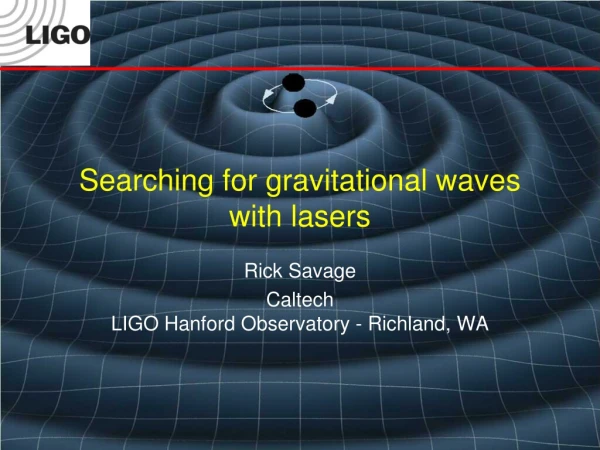
Searching for gravitational waves with lasers Rick Savage CaltechLIGO Hanford Observatory - Richland, WA
Black holes and time warps • Sept 1974 - transferred to UCLA in Physics • Jan 1975 - started working for F. Chen and N. Luhmann as undergraduate lab assistant (with Doug Cook) • 1976 to1986 - plasma diagnostics with N. Luhmann, T. Peebles, H. Fetterman, et al. • 1986 to 1992 - graduate school in EE at UCLA withChan Josh, Warren Mori, Ken Marsh, Chris Clayton, et al. • Masters thesis – Degenerate four-wave mixing in heated CO2 gas • PhD thesis – Frequency upshifting of electromagnetic radiation via an underdense relativistic ionization front • 1992 to present - LIGO project at Caltech until 1997 then LIGO Hanford Observatory in Richland, WA UCLA Symposium F2C@80 Nov. 2009
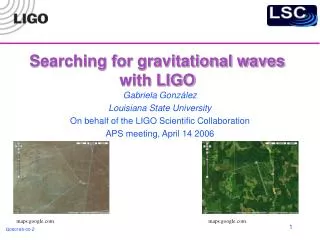
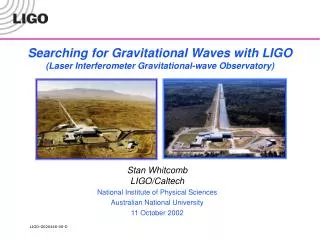
LIGO: Laser Interferometer Gravitational-wave Observatory Hanford, WA MIT 3002 km (L/c = 10 ms) Caltech • Managed and operated by Caltech & MIT with funding from NSF • Goal: Direct observation ofgravitational waves • Open an new observationalwindow on the Universe Livingston, LA
LIGO Scientific Collaboration LIGO Scientific Collaboration • University of Michigan • University of Minnesota • The University of Mississippi • Massachusetts Inst. of Technology • Monash University • Montana State University • Moscow State University • National Astronomical Observatory of Japan • Northwestern University • University of Oregon • Pennsylvania State University • Rochester Inst. of Technology • Rutherford Appleton Lab • University of Rochester • San Jose State University • Univ. of Sannio at Benevento, and Univ. of Salerno • University of Sheffield • University of Southampton • Southeastern Louisiana Univ. • Southern Univ. and A&M College • Stanford University • University of Strathclyde • Syracuse University • Univ. of Texas at Austin • Univ. of Texas at Brownsville • Trinity University • Tsinghua University • Universitat de les IllesBalears • Univ. of Massachusetts Amherst • University of Western Australia • Univ. of Wisconsin-Milwaukee • Washington State University • University of Washington • Australian Consortiumfor InterferometricGravitational Astronomy • The Univ. of Adelaide • Andrews University • The Australian National Univ. • The University of Birmingham • California Inst. of Technology • Cardiff University • Carleton College • Charles Sturt Univ. • Columbia University • CSU Fullerton • Embry Riddle Aeronautical Univ. • EötvösLoránd University • University of Florida • German/British Collaboration forthe Detection of Gravitational Waves • University of Glasgow • Goddard Space Flight Center • Leibniz Universität Hannover • Hobart & William Smith Colleges • Inst. of Applied Physics of the Russian Academy of Sciences • Polish Academy of Sciences • India Inter-University Centrefor Astronomy and Astrophysics • Louisiana State University • Louisiana Tech University • Loyola University New Orleans • University of Maryland • Max Planck Institute for Gravitational Physics UCLA Symposium F2C@80 Nov. 2009
General relativity – gravitational waves “Matter tells spacetime how to curve.Spacetime tell matter how to move.”J. A Wheeler Albert Einstein1916 GW: oscillating quadrupolar strain in spacetime Laser Interferometer UCLA Symposium F2C@80 Nov. 2009
Potential sources • Coalescing Binary Systems • Neutron stars, low mass black holes, and NS/BS systems ‘Bursts’ galactic asymmetric core collapse supernovae cosmic strings ??? Credit: AEI, CCT, LSU Credit: Chandra X-ray Observatory Cosmic GW background stochastic,incoherent background Continuous Sources Spinning neutron stars probe crustal deformations UCLA Symposium F2C@80 Nov. 2009 Casey Reed, Penn State NASA/WMAP Science Team
Capturing the waveform Sketch: Kip Thorne UCLA Symposium F2C@80 Nov. 2009
Detection of gravitational waves Michelson interferometer - differential length change sensor UCLA Symposium F2C@80 Nov. 2009
Ligo detectors Power Recycled Michelson Interferometer with Fabry-Perot Arm Cavities 4 km-longFabry-Perotarm cavity recycling mirror test masses Laser beam splitter signal UCLA Symposium F2C@80 Nov. 2009
Beam tubes and chambers • Beam tubes: • 1.2 m diameter • LN2 pumps at ends • P < 1e-09 torr • dominated by H2 UCLA Symposium F2C@80 Nov. 2009
Isolated environment for test masses UCLA Symposium F2C@80 Nov. 2009
Suspended test masses UCLA Symposium F2C@80 Nov. 2009
Initial LIGO displacement sensitivity Antenna patterns NS-NS binary inspiral range ~ 15 Mpc (S/N = 8) +pol S5 science run Nov. `05toOct `07 Gpol avg UCLA Symposium F2C@80 Nov. 2009
Scientific results of S5 run • No detections (so far) - data still being analyzed • Astrophysical results – upper limits“If LIGO didn’t detect it, then it can’t be bigger than …” • CRAB pulsar – “no more than 4 percent of the energy loss of the pulsar is caused by the emission of gravitational waves.”(ApJL 683, L45) • Gamma ray burst GRB 070201 – LIGO “results give an independent wayto reject hypothesis of a compact binaryprogenitor in M31”(ApJ 2008, 681, 1419) • Upper limit on the stochastic gravitational wave background(http://www.nature.com/nature/journal/v460/n7258/pdf/nature08278.pdf) Credits for X-ray Image: NASA/CXC/ASU/J. Hester et al. Credits for Optical Image: NASA/HST/ASU/J. Hester et al. UCLA Symposium F2C@80 Nov. 2009
What’s next? Advanced Ligo. • Quantum noise limited interferometer • Factor of 10 increase in sensitivity • Factor of 1000 increase in event rate UCLA Symposium F2C@80 Nov. 2009
Laser source: 10 W to 200 W Diode-pumpedYAG lasers UCLA Symposium F2C@80 Nov. 2009
Vibration isolation: passive to active • Masses anddamped springs • Geophones and accelerometers on payload • Active feedback control – 6 deg. of freedom UCLA Symposium F2C@80 Nov. 2009
Test mass suspensions • Single pendulum • Quadruple pendulumwith reaction masses • 40 kg test masses UCLA Symposium F2C@80 Nov. 2009
Time warp – 1763 Boelter Hall UCLA Symposium F2C@80 Nov. 2009
To Frank ……. thank you. UCLA Symposium F2C@80 Nov. 2009