Mastering Multiple Choice Strategies for Exam Success
Enhance your test-taking skills with effective strategies for tackling multiple-choice questions. Learn how to thoroughly read questions and choices, identify correct answers and eliminate options that do not apply. This guide provides key tactics such as anticipating answers, recognizing patterns, and managing uncertainty. You will discover best practices for narrowing down choices and have the confidence to approach even the toughest questions. Excel in your exams by applying these proven strategies!

Mastering Multiple Choice Strategies for Exam Success
E N D
Presentation Transcript
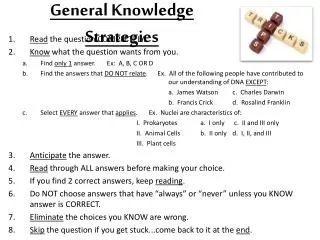
General Knowledge Strategies • Readthe question COMPLETELY. • Know what the question wants from you. a. Find only 1 answer. Ex: A, B, C OR D b. Find the answers that DO NOT relate. Ex. All of the following people have contributed to our understanding of DNA EXCEPT: a. James Watson c. Charles Darwin b. Francis Crick d. Rosalind Franklin c. Select EVERY answer that applies. Ex. Nuclei are characteristics of: I. Prokaryotes a. I only c. II and III only II. Animal Cells b. II only d. I, II, and III III. Plant cells • Anticipate the answer. • Read through ALL answers before making your choice. • If you find 2 correct answers, keep reading. • Do NOT choose answers that have “always” or “never” unless you KNOW answer is CORRECT. • Eliminate the choices you KNOW are wrong. • Skip the question if you get stuck...come back to it at the end.
Other COOL Hints • What if I find 2 answers? • If you are sure that 2 answers are correct, then it is safe to assume that the 3rd answer is correct as well (assuming that one of your choices says “all of the above”) • For a MC answer to be true, ALL parts of it must be TRUE • Ex. Which of the following are found in facilitated diffusion? A. Active transport, transmembrane proteins and molecules.