SlideServe
Menu
Préférences
© SlideServe · v2026

Multiphase LB Models

gray-christian avatar
29 diapositives · 507 Views · Nov 21, 2014

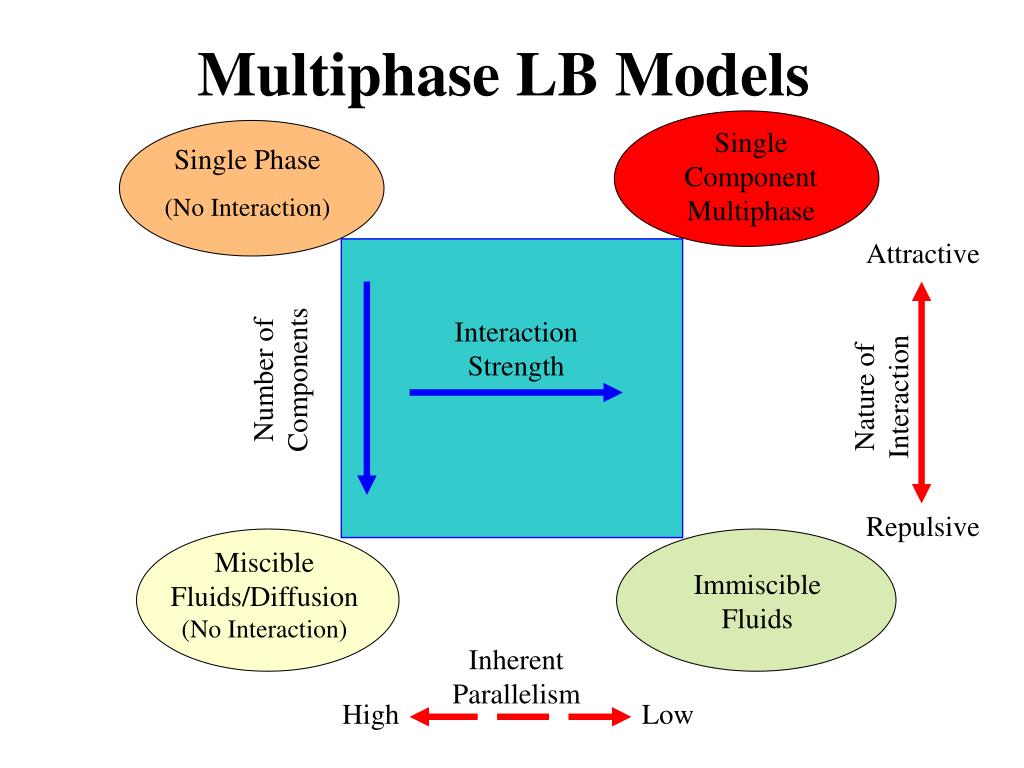
Multiphase LB Models. Single Component Multiphase. Single Phase (No Interaction). Attractive. Interaction Strength. Number of Components. Nature of Interaction. Multi- Component Multiphase. Repulsive. Miscible Fluids/Diffusion (No Interaction). Immiscible Fluids. Inherent Parallelism.
Multiphase LB Models - slide 1
01 / 29Multiphase LB Models
1 / 17

Télécharger la présentation

Multiphase LB Models
Une image / un lien ci-dessous est fourni (tel quel) pour télécharger la présentation

Politique de téléchargement : le contenu du site vous est fourni TEL QUEL pour votre information et votre usage personnel ; il ne peut être vendu, concédé sous licence ni partagé sur d’autres sites sans l’accord de son auteur.Le contenu vous est fourni TEL QUEL, pour votre information et votre usage personnel uniquement. Téléchargez la présentation en cliquant sur ce lien. Lors du téléchargement, si vous ne parvenez pas à télécharger une présentation, l’éditeur a peut-être supprimé le fichier de son serveur.Pendant le téléchargement, si vous ne parvenez pas à obtenir une présentation, le fichier a peut-être été supprimé par l’éditeur.

F I N

Plus de contenu associé

Transcription de la présentation
  1. Multiphase LB Models Single Component Multiphase Single Phase (No Interaction) Attractive Interaction Strength Number of Components Nature of Interaction Multi- Component Multiphase Repulsive Miscible Fluids/Diffusion (No Interaction) Immiscible Fluids Inherent Parallelism High Low

  2. Equations of State • Perfect (Ideal) gas law • van der Waals gas law • Molar volumes • Temperature dependence and Critical Points • Liquid-vapor coexistence and the Maxwell Construction • Water and the non-quantitative nature of the van der Waals equation • Alternative presentation: P(r) • Modern EOS for water

  3. Perfect or ideal gas law (EOS) • P is pressure (ATM) • V is volume (L) • n is number of mols • R is gas constant (0.0821 L atm mol-1 K-1) • T is temperature (K)

  4. Molar Volume Vm = V/n is the volume occupied by one mole of substance. The gas laws can be re-written to eliminate the number of moles n Perfect or ideal gas law (EOS):

  5. Single Component D2Q9 LBM (with c = 1 lu ts-1) So, if 1/Vm (mol L-1) is density, cs2 = RT

  6. van der Waals EOS Perfect or ideal gas law (EOS): van der Waals EOS: • ‘a’ term due to attractive forces between molecules [atm L2 mol-2] • ‘b’ term due to finite volume of molecules [L mol-1]

  7. Molar Volume Vm is the volume occupied by one mole of substance. The gas laws can be re-written to eliminate the number of moles n. van der Waals gas law (EOS):

  8. CO2: P-V Space

  9. Liquid-Vapor Coexistence: CO2, P-V Space a = 3.592 L6 atm mol-2 b = 0.04267 L3 mol-1 Vapor Pressure Vapor Molar Volume Liquid Molar Volume

  10. Maxwell Construction: CO2, P-V Space Maxwell Construction: Area A = Area B Gives: --vapor pressure--densities of coexisting liquid and vapor Vapor Pressure B Vapor Molar Volume A Liquid Molar Volume Flat interfaces only!

  11. Water, 298K: P-V Space

  12. van der Waals Non-Quantitative:Water, 298K: P- r Space Pvap

  13. Including Directional H-Bonds:Water, 298K: P- r Space Spinodal

  14. Recap • van der Waals equation gives a simple qualitative explanation of phase separation based on molecular attraction and finite molecular size • Maxwell construction gives the vapor pressure and the densities of coexisting liquid and gas at equilibrium, FOR FLAT INTERFACES • van der Waals equation fails to quantitatively reproduce the EOS of water

  15. FHP LBM Fluid Cohesion • An attractive force F between nearest neighbor fluid particles is induced as follows: • G is the interaction strength • Y is the interaction potential: • Y0 and r0 are arbitrary constants Other forms possible/common Shan, X. and H. Chen, 1994. PRE 49, 2941-2948.

  16. D2Q9 SCMP LBM Fluid-Fluid Interaction wa is 1/9 for a = 1, 2, 3, 4 and is 1/36 for a = 5, 6, 7, 8 G <0 for attraction between particles Force is stronger when the density is higher

  17. Incorporating Forces F = ma = m du/dt U = u + tF1/r + tF2/r + ...

  18. LBM Non-ideal Equation of State Non-ideal Component Shan and Chen, 1994. PRE 49, 2941-2948 No repulsive potential in LB model Realistic EOS for water: Follows ideal gas law at low density, compressibility of water at high density and spinodal at high tension Liquid/vapor coexistence at equilibrium (and flat interface) determined by Maxwell construction Water EOS after Truskett et al., 1999. J. Chem. Phys. 111, 2647-2656.

  19. Simplified EOS

  20. Single Component Multiphase Modifications to code

  21. Eqs. 60 and 61 // Compute psi, Eq. (61). for( j=0; j<LY; j++) for( i=0; i<LX; i++) if( !is_solid_node[j][i]) { psi[j][i] = 4.*exp( -200. / ( rho[j][i])); }

  22. Eqs. 60 and 61 // Compute interaction force, Eq. (60) assuming periodic domain. for( j=0; j<LY; j++) { jp = ( j<LY-1)?( j+1):( 0 ); jn = ( j>0 )?( j-1):( LY-1); for( i=0; i<LX; i++) { ip = ( i<LX-1)?( i+1):( 0 ); in = ( i>0 )?( i-1):( LX-1); Fx = 0.; Fy = 0.; if( !is_solid_node[j][i]) { Fx+= WM*ex[1]*psi[j ][ip]; Fy+= WM*ey[1]*psi[j ][ip]; Fx+= WM*ex[2]*psi[jp][i ]; Fy+= WM*ey[2]*psi[jp][i ]; Fx+= WM*ex[3]*psi[j ][in]; Fy+= WM*ey[3]*psi[j ][in]; Fx+= WM*ex[4]*psi[jn][i ]; Fy+= WM*ey[4]*psi[jn][i ]; Fx+= WD*ex[5]*psi[jp][ip]; Fy+= WD*ey[5]*psi[jp][ip]; Fx+= WD*ex[6]*psi[jp][in]; Fy+= WD*ey[6]*psi[jp][in]; Fx+= WD*ex[7]*psi[jn][in]; Fy+= WD*ey[7]*psi[jn][in]; Fx+= WD*ex[8]*psi[jn][ip]; Fy+= WD*ey[8]*psi[jn][ip]; Fx = -G * psi[j][i] * Fx; Fy = -G * psi[j][i] * Fy; } } }

  23. Phase Separation

  24. Young-Laplace Eqn (1805) ∞ r

  25. Young-Laplace Eqn (1805)

  26. Measuring Surface Tension