SlideServe
Menu
Préférences
© SlideServe · v2026

Particulate and Multiphase Processes

salene avatar
10 diapositives · 280 Views · Sep 04, 2014

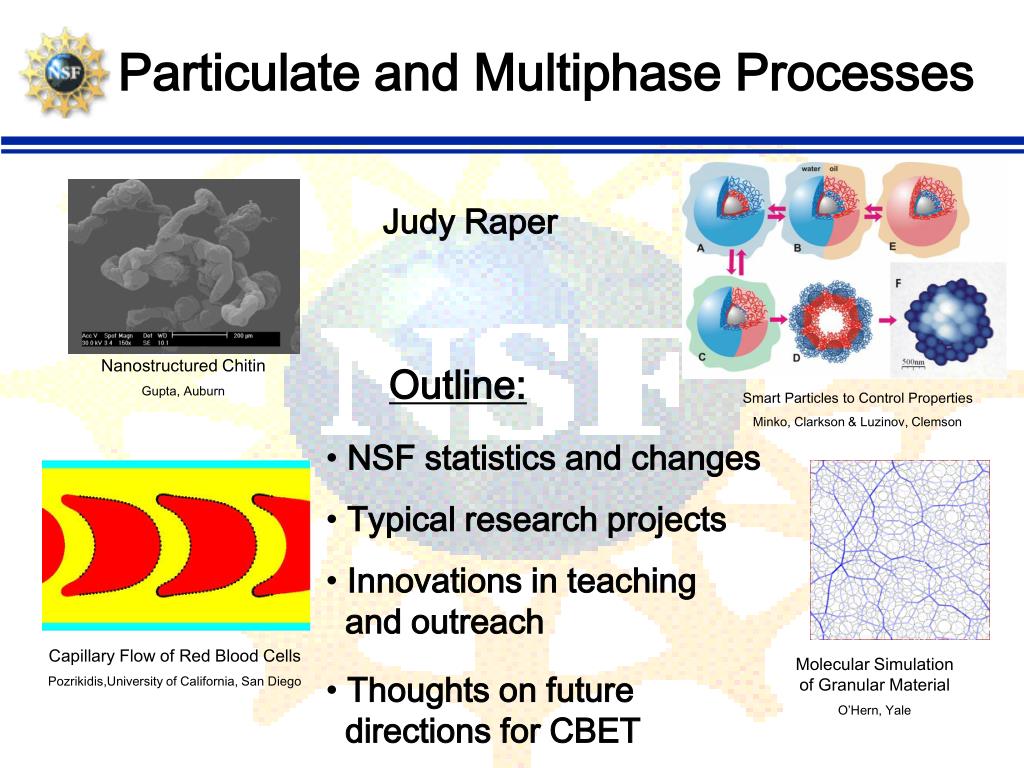
Particulate and Multiphase Processes. Judy Raper Outline: NSF statistics and changes Typical research projects Innovations in teaching and outreach Thoughts on future directions for CBET. Nanostructured Chitin Gupta, Auburn. Smart Particles to Control Properties
Particulate and Multiphase Processes - slide 1
01 / 10Particulate and Multiphase Processes
1 / 17

Télécharger la présentation

Particulate and Multiphase Processes
Une image / un lien ci-dessous est fourni (tel quel) pour télécharger la présentation

Politique de téléchargement : le contenu du site vous est fourni TEL QUEL pour votre information et votre usage personnel ; il ne peut être vendu, concédé sous licence ni partagé sur d’autres sites sans l’accord de son auteur.Le contenu vous est fourni TEL QUEL, pour votre information et votre usage personnel uniquement. Téléchargez la présentation en cliquant sur ce lien. Lors du téléchargement, si vous ne parvenez pas à télécharger une présentation, l’éditeur a peut-être supprimé le fichier de son serveur.Pendant le téléchargement, si vous ne parvenez pas à obtenir une présentation, le fichier a peut-être été supprimé par l’éditeur.

F I N

Plus de contenu associé

Transcription de la présentation
  1. Particulate and Multiphase Processes • Judy Raper • Outline: • NSF statistics and changes • Typical research projects • Innovations in teaching • and outreach • Thoughts on future • directions for CBET Nanostructured Chitin Gupta, Auburn Smart Particles to Control Properties Minko, Clarkson & Luzinov, Clemson Capillary Flow of Red Blood Cells Pozrikidis,University of California, San Diego Molecular Simulation of Granular Material O’Hern, Yale

  2. PARTICULATE AND MULTIPHASE PROCESSES (PMP) Fundamental research on transport phenomena in dispersed and microstructured systems • Physics and dynamics of particulate & multiphase flows • Interfacial flow phenomena and rheology of structured fluids • Advances in particle transport and diagnostics

  3. Current Research Focus • MULTIPHASE FLOW PHENOMENA & MICROSTRUCTURED FLUIDS (20%) bubble/droplet dynamics; particle-laden flows; multiphase flows in microfluidic devices; colloids, self and directed assembly • PARTICLE TECHNOLOGY (30%) Fluidization, granular flows; suspensions; production of particles with engineered characteristics, unique composition, and surface properties; particle assembly into functional structures and devices • MULTI-SCALE MODELS OF DISPERSED SYSTEMS (15%) Fundamental models bridging particle-scale properties with process-scale variables • INSTRUMENTATION AND DIAGNOSTICS (10%) Development of sensors for probing the 3D microstructure of dispersed multiphase flows, fluidized beds, and granular flows; instrumentation for online monitoring and control • ENVIRONMENTAL (10%) Processes leading to new technologies for environmental sustainability • MULTIPHASE TRANSPORT IN BIOLOGICAL SYSTEMS(15%) Multiphase transport in biological systems with applications to clinical diagnostics and therapeutics

  4. Trends in Funding The PMP program is broad in scope and relevance Submission windows for unsolicited proposals: September & February. Emphasis is on: • Innovative ideas with significant impact on science and engineering, • Exploratory projects with potential for breakthrough results • Fundamental, high-risk / high-gain projects with clear objectives and potential for discovery of new phenomena • Broader Impacts (integration of research & education, outreach, involvement of under-represented groups, societal issues) Typical Level of Support: 1-2 Investigator Regular Grants 250-350k/3yrs Small Grants for Exploratory Research 30 - 80k/yr (up to 2 years) CAREER Awards 400k/5yrs We encourage PIs to include requests for research instrumentation in regular unsolicited proposals (~50-60k per proposal)

  5. Additional Funding Opportunities Special Solicitations: • Nanoscale Science and Engineering (NSE) – (NIRT & NER grants) • Sensors and Sensor Networks • Major Research Instrumentation (MRI) Awards • Mathematical Sciences Priority Area (MSPA) • EFRI Interactions with Industry: * Grant Opportunities for Academic Liaison with Industry (GOALI) Educational and Training Grants: Integrative Graduate Education and Research Training (IGERT) Research Experience for Undergraduates (REU) Research Experience for Teachers (RET) Grants and Supplements for International Collaboration (INT) International Research and Education in Engineering (IREE)

  6. Special Interest Programs • CAREER Awards Program Targets the career development of beginning investigators • Experimental Program to Stimulate Competitive Research (EPSCoR) Targets the economic stimulation of specific States • SGER Awards Preference is given to untenured faculty and underrepresented minorities in science and engineering • ADVANCE Program Aims to increase the representation of women in academic science and engineering careers • Various Educational Grant Solicitations

  7. What Makes a Proposal Competitive? Intellectual Merit • Likely high impact in science/technology • New and original ideas – sound scientific rationale • Succinct and focused project plan – sufficient detail • Knowledge of subject area and published, relevant work • Experience in essential methodology • Clarity concerning future directions • Realistic amount of work • Critical approach Broader Impacts • Integration of Research and Education • Outreach Activities • Plans for Involvement of Underrepresented Groups • Broad Dissemination of Results • Benefits to Society (both scientific and general)

  8. Conclusions For more information go to: http://www.nsf.gov

  9. PMP - Trends in Funding (2003-2006)

  10. Program Expenditures