Understanding Electromagnetic Induction: From Generators to Current Flow in Conductors
Electromagnetic induction occurs when changing magnetic fields create a potential difference in a conductor, leading to current flow. This principle is fundamental to the operation of generators, transformers, induction coils, and even magnetic levitation systems. By applying the formula V = Blv, we can calculate induced voltage, where V is the potential difference, B is the magnetic flux, l is the wire length, and v is its speed. This concept not only illustrates how mechanical energy can be converted into electrical energy, but also highlights the essential role of magnetic fields in generating electricity.

Understanding Electromagnetic Induction: From Generators to Current Flow in Conductors
E N D
Presentation Transcript
Changing magnetic fields can create a potential difference (and thus cause current flow) in a conductor. This is the principle behind generators, transformers, induction coils, and magnetic levitation (superconductors, trains).
Electromagnetic Induction A motor uses a magnetic field to convert electrical energy to mechanical energy. The reverse can also be done. Devices that convert mechanical energy to electrical energy are called generators.
A wire moving perpendicular to a magnetic field will experience an induced voltage, and thus a current. The wire must cut across field lines, so the more field lines, the more current.
We can calculate the induced voltage by using: V = Blv V = induced potential difference B = magnetic flux l = length of the wire v = speed of the wire
Practice Problem: Calculate the potential difference induced in a wire 0.20 m long and moved 8.0 m/s through a 4.0x10 -1 T magnetic field. l = 0.20 m v = 8.0m/s B = 4.0 x 10 -1 T V = Blv V = (4.0 x 10 -1 T)(0.20m)(8.0m/s) V = 0.64 V
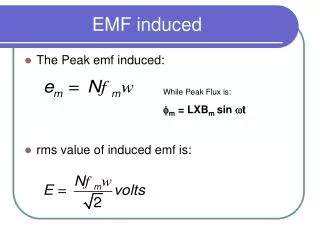
Induced potential difference is also known as electromotive force (emf). Only a change in magnetic field is necessary - not actual motion. So a changing magnetic field will also cause an induced voltage.
Generators A device that converts mechanical energy (falling water, steam, hand crank, etc) into electrical energy.
To make a simple generator, wrap a coil of wire around and iron core, place it in a magnetic field, and rotate.
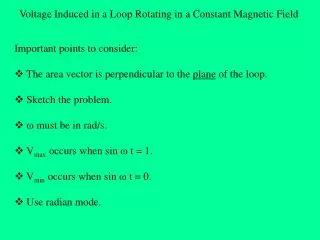
When the coil is perpendicular to the field lines, current is high. When the coil is parallel, the current is zero. When it is in between, the current is in between. This is AC - alternating current
Find the direction of current flow: X X X X X
Find direction of induced current flow: Wire is pushed into the page N e - S
Find the field: X X X X X X X X e - X X X X F X X X X
Find the direction of induced current: X X X X X X X X v e - F X X X X X X X X