
SlideServe
Menu
Préférences
© SlideServe · v2026

Fibroblast Growth Factors (FGFs)

guinevere-campbell avatar
15 diapositives · 614 Views · Nov 20, 2014

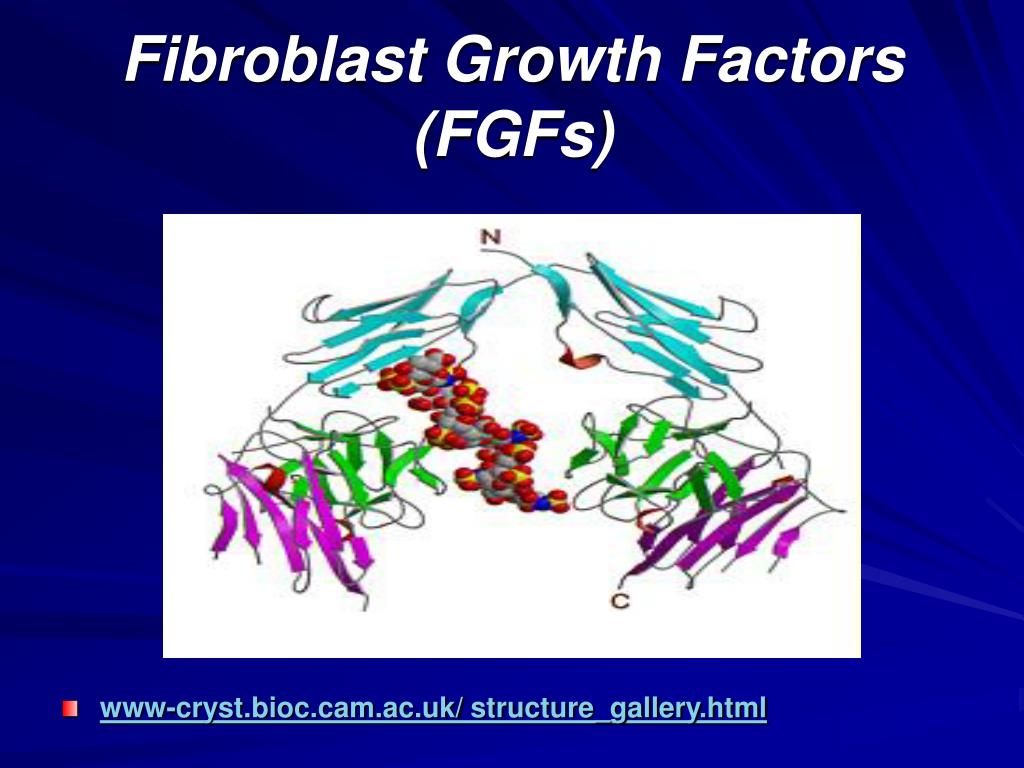
Fibroblast Growth Factors (FGFs). www-cryst.bioc.cam.ac.uk/ structure_gallery.html. Definition. According to General Practice Notebook: Fibroblast Growth Factor is a peptide with cellular communication abilities e.g. Stimulation of fibroblast and endothelial cell division
Fibroblast Growth Factors (FGFs) - slide 1
01 / 15Fibroblast Growth Factors (FGFs)
1 / 17

Télécharger la présentation

Fibroblast Growth Factors (FGFs)
Une image / un lien ci-dessous est fourni (tel quel) pour télécharger la présentation

Politique de téléchargement : le contenu du site vous est fourni TEL QUEL pour votre information et votre usage personnel ; il ne peut être vendu, concédé sous licence ni partagé sur d’autres sites sans l’accord de son auteur.Le contenu vous est fourni TEL QUEL, pour votre information et votre usage personnel uniquement. Téléchargez la présentation en cliquant sur ce lien. Lors du téléchargement, si vous ne parvenez pas à télécharger une présentation, l’éditeur a peut-être supprimé le fichier de son serveur.Pendant le téléchargement, si vous ne parvenez pas à obtenir une présentation, le fichier a peut-être été supprimé par l’éditeur.

F I N

Plus de contenu associé

Transcription de la présentation
  1. Fibroblast Growth Factors (FGFs) • www-cryst.bioc.cam.ac.uk/ structure_gallery.html

  2. Definition • According to General Practice Notebook: • Fibroblast Growth Factor is a peptide with cellular communication abilities e.g. • Stimulation of fibroblast and endothelial cell division • Stimulation of angiogenesis

  3. FGFs Function in the Cell • FGF is a ligand that binds to Fibroblast Growth Factor Receptors (FGFR), which in turn through tyrosine phosphorylation propagate signals through transduction pathway

  4. Cell Lines • FGFs induce mitogenic, chemotactic, and angiogenic activity • What effects does FGF have in the Mouse?

  5. Knock-Out Mice • Dr. Miller et al, decided to knock-out: • FGF-1 • FGF-2 • Double Knock-out of FGF-1 and FGF-2 • There results were:

  6. Mouse Knock-outs had no major phenotypic variation from wild-type • Why these results?

  7. There are 22 known FGFs • It is thought that the redundancy among the 22 Fibroblast Growth Factors compensate for the knock-out of FGF-1 and FGF-2

  8. Angiogenesis is: • The formation of new capillary blood vessels from pre-existing ones • Requires migration, proliferation and differentiation of endothelial cells into blood vessels • Plays an important role in wound healing • Plays an important role in cancer as well

  9. Angiogenic Factors: FGF and VEGF

  10. Tumor Cells release angiogenic factors • Some scientist suggest that a tumor requires blood supply in order to grow beyond a few cubic millimeters • A tumor cell releases FGF and VEGF • As a result of receptor activation, endothelial cells will secrete proteases • The proteases digest basement membrane, which migrate and proliferate to form new blood vessels

  11. FGF-3 (int-2) • Primarily expressed during development • First discovered in mouse mammary carcinogenesis • MMTV induces mammary tumors by acting as an insertional mutagen, and activating transcription of the nearby genes • FGF-3 (int) was found to be the site where the mouse mammary tumor virus (MMTV) usually integrates

  12. Mouse Mammary Tumor Virus • Activates the promoter for FGF-3 • This “turns on” FGF-3 at improper times during development

  13. MMTV and Human Breast Cancer • Detectable MMTV env gene-related antigenic reactivity has been found in tissue sections of human breast cancer • The human homologue of the int-2 locus has been found to be amplified and expressed in 15% of the breast cancers • There are still no clear proof that the human homologs to MMTV are related to human breast cancer

  14. Breast Cancer • Dr. Granato et al., researched the effects of FGFs in breast cancer • They concluded that bFGF (basic fibroblast growth factor) serum level is associated with the presence of breast cancer • They proposed that bFGF as a noninvasive diagnostic tool for breast cancer

  15. There are Elevated Levels of FGF in Breast Cancer Patients