Download
1 / 1
20 likes | 144 Vues
Luxel Corporation has developed optimized polyimide thin film X-ray filter substrates for use at cryogenic temperatures, enhancing strength and performance for high-resolution X-ray spectroscopy. These filters withstand launch loads and long-term cryogenic operation. After refining processing parameters, including cure cycles, the burst strength increased by 36%, enabling thinner windows and higher internal pressures. Commercially available, these innovative filters are designed to improve mission performance in future astronomical experiments while reducing costs, exemplified by applications in the National Ignition Facility at 18K.

E N D
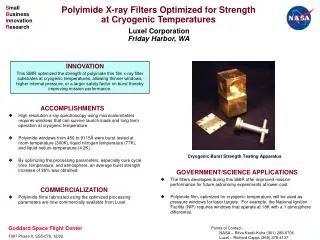
Small Business Innovation Research Polyimide X-ray Filters Optimized for Strengthat Cryogenic TemperaturesLuxel CorporationFriday Harbor, WA • INNOVATION This SBIR optimized the strength of polyimide thin film x-ray filter substrates at cryogenic temperatures, allowing thinner windows, higher internal pressure, or a larger safety factor on burst thereby improving mission performance. • ACCOMPLISHMENTS • High resolution x-ray spectroscopy using microcalorimeters requires windows that can survive launch loads and long term operation at cryogenic temperature. • Polyimide windows from 450 to 9115Å were burst tested at room temperature (300K), liquid nitrogen temperature (77K), and liquid helium temperature (4.2K). • By optimizing the processing parameters, especially cure cycle time, temperature, and atmosphere, an average burst strength increase of 36% was obtained. COMMERCIALIZATION • Polyimide films fabricated using the optimized processing parameters are now commercially available from Luxel. Cryogenic Burst Strength Testing Apparatus • GOVERNMENT/SCIENCE APPLICATIONS • The filters developed during this SBIR offer improved mission performance for future astronomy experiments at lower cost. • Polyimide film, optimized for cryogenic temperature, will be used as pressure windows for laser targets. For example, the National Ignition Facility (NIF) requires windows that operate at 18K with a 1 atmosphere differential. Goddard Space Flight Center Points of Contact: NASA – Ritva Keski-Kuha (301) 286-6706 Luxel – Richard Capps (360) 378-4137 1997 Phase II, SS5-078, 12/02