Mastering Dimensional Analysis for Efficient Unit Conversions
Learn the foolproof process of creating and using conversion factors to convert between units effortlessly. Understand the basics, practice with examples, and nail down the technique with ease!

Mastering Dimensional Analysis for Efficient Unit Conversions
E N D
Presentation Transcript
Dimensional Analysis Converting
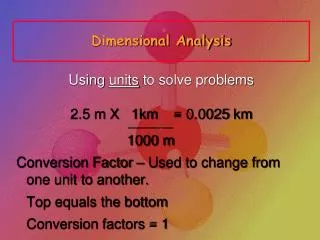
REMEMBER THAT: • ***This is a process…even if you know how to do it another way…DON’T…I am teaching you the process! • A conversion factor is ALWAYS equal to one • (because when you divide something by another quantity that is equal to it, it is like dividing that number by itself, which always equals ONE)
Creating Conversion Factors 16 cups = 1 gal 1000 mL = 1 L 5280 ft = 1 mile
NOTICE: • One of the #’s in the conversion is always 1 • Can apply to metric units. • Bigger unit is going to be 1 1 km and 1000m 1000m 1 km 1 km = 1000 m 1 g = 100cg 1g and 100cg 100cg 1g
How to use the conversion factors. • Since conversion factors have a value of 1, when you multiply by them, although the number (and units) may change, the value stays the same, since you’re just multiplying by 1.
Rules • Set up a grid. (with as many sections as you need)
Rules • Place # and unit of what you are given in first space of grid.
Rules • Place conversion factor with unit you are given on bottom of grid and unit of what you want on top in next space.
Rules • Repeat step 3 if needed.
Example • 205 km = ____m • 4 cg = ____g = 205 000 m = .04 g Don’t forget units! Don’t forget units!