The Duality of Khrushchev: Hardliner vs. Reformer During the Cold War
This analysis explores the complex identity of Nikita Khrushchev as both a hardliner and a reformer during the Cold War. It examines his role in domestic policies, such as de-Stalinization and liberalization, juxtaposed against his aggressive foreign policy stance, epitomized by the Cuban Missile Crisis and the Space Race. The impact of his leadership on Eastern Europe, particularly in Poland and Hungary, is also scrutinized, revealing how his dual nature shaped the trajectory of Cold War tensions and reform movements.

The Duality of Khrushchev: Hardliner vs. Reformer During the Cold War
E N D
Presentation Transcript
Samantha Stevens Serena -->
Jeanie Sister Jeanie
The Two Khrushchevs Hard Liner? Reformer?
The Friendly Khrushchev DOMESTIC POLICY • De-Stalinization * 20th Party Congress * “the Secret Speech” * Denounced Stalin! * Stalin’s body removed from red square
The Friendly Khrushchev DOMESTIC POLICY B. REFORMS * Dismantled Gulags * Rehabilitation * Liberalized government.
The Friendly Khrushchev FOREIGN POLICY A. “Peaceful Coexistence” * Competition between Systems. * Visited U.S. * “the Kitchen Debate” Ok, there IS no B : (
The Friendly Khrushchev FOREIGN POLICY A. “Peaceful Coexistence” * Competition between Systems. * Visited U.S. * “the Kitchen Debate” Ok, there IS no B : (
The OTHER Khrushchev “We will crush you!” Third World Revolution
The OTHER Khrushchev “We will crush you!” Third World Revolution Technology: Sputnik - Space Race
The OTHER Khrushchev “We will crush you!” Third World Revolution Technology: ICBMs - Missile Gap Sputnik - Space Race
I.C.B.M.sThe Missile Gap!!! THE REALITY: US – 300 ICBMs , - Polaris Fleet USSR – 10 ICBMs, - 100s short range
The OTHER Khrushchev “We will crush you!” Third World Revolution Technology: ICBMs - Missile Gap Sputnik - Space Race
Don’t Forget This . . . Old Guard - Hard Liners “Too Much Too Fast!” Precarious Position. He’s got to watch his back. Sometimes . . . It’s not about us.
Berlin Wall AUGUST 13, 1961
Cuban Missile Crisis October 14, 1962 Recon Planes Report October 22, 1962. Blockade, DEFCON 3 OCTOBER 28, the Soviets “blink”
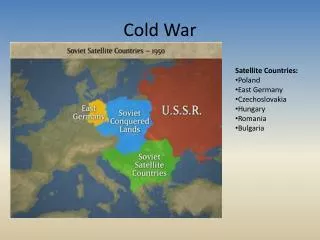
EASTERN EUROPE Poland / Hungary / Czechoslovakia
Poland 1956 • Popular Uprising Poznan Hardliner Polish Government Represses • Gomulka becomes Party Secretary Promises Reforms “Polish Way toward Socialism” Gomulka Communist leader 1956 - 1970
III. Soviet Response? A. Troop Maneuvers on the border B. A “visit”
III. Soviet Response? Khrushchev Gomulka Gomulka Backs down, Khrushchev backs off
Hungary 1956 I. New Reform Government (late October) II. Popular Movement (inspired by Poland)
HUNGARY 1956 Imry Nagy /NAHJD/ New Hungarian Communist leader 1953-55, 1956 (Prime Minister) Reform Minded: - appointed non-communist ministers - abolished one-party rule - political prisoners released
HUNGARY 1956 Imry Nagy /NAHJD/ New Hungarian Communist leader 1953-55, 1956 (Prime Minister) The Last Straw 11/01/56 - U.N. suggested neutrality - out of the Warsaw Pact
Soviet Response? Soviet Tanks Roll in 11/04/56
11/04 to 11/10 2,500 killed
Nagy’s Fate? Arrested, Tried, Hanged 1958 “Rehabilitated” in ‘89
WHY Didn’t We do something? Gammel Nasser EGYPT 1. Aswan High Dam 2. Suez Canal Crisis Egypt vs England / France
1964: Khrushchev is ousted Leonid Breznev Old Guard Stagnation. Military Spend ing
Alexander Dubcek 1st Secretary of the Communist Party Action Programme “Socialism with a human face” Free Press, Consumer Goods
Alexander Dubcek 1st Secretary of the Communist Party Action Programme “PRAGUE SPRING” Democratization De-Centralization
Soviet Response? 200,000 - 600,000 Warsaw Pact troops
Brezhnev The Brezhnev Doctrine?
1968 to 1989Stasis . . . And then all heck breaks loose
1989: First Wave • Poland: • April: Solidarity Legalized / participate in elections Lech Walesa Solidarity
1989: First Wave Pope John Paul II Lech Walesa Solidarity
1989: First Wave • Poland: • April: Solidarity Legalized / participate in elections • June: 99/100 seats and the Presidency • New Non-Communist Government???