Development of Thermoelectric Power System for RIT Cook Stove in Haiti
This project aims to create a thermoelectric generator (TEG) power system specifically for the first generation of RIT cook stoves. Targeting Haitian vendors, the system will produce 4W output under a 200°C temperature difference and provide controlled air flow options for boiling and simmering. Key challenges include improving TEG cooling, enhancing power production, and ensuring system reliability for auxiliary device charging via USB. Future work will focus on optimizing mechanical and electrical components to meet the end user's needs while addressing current performance and budget issues.
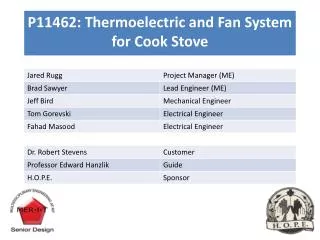

Development of Thermoelectric Power System for RIT Cook Stove in Haiti
E N D
Presentation Transcript
Project Description • Goal: Develop a thermoelectric (TEG) power system for the first generation of RIT cook stove (project P10461) • End user: Haitian Vendor • Key needs and specs: • Use of TEG • 4 W output at 200 °C temp difference • Provide controllable air flow into stove • Flow Rate 0.3-0.7 kg/min • 2 Control Settings (Boil, Simmer) • Charge an auxiliary device • Power 5 V USB device
Design Concept Fan Electrical system Heat conduction beam Heat sink TEG (sandwiched between beam and heat sink) Bypass
High Risk Assessment • Insufficient TEG cooling • TEG producing too little power • Heat conduction rod produces too little heat • Electrical system consumes too much power • Product cost
Current State of Design - Performance • Design meets customer needs except: • 5 year life-span • Well packaged system • Ability to charge auxiliary device • Fan runs at start-up • Design meets engineering specs except: • Unit price • Product life span • Replaceable component life span • Aux charging • Volume • Time to reach peak performance
Current State of Design – Budget/Schedule • Budget = $500 • Total Amount Spent = $601 • Total Cost of System = Unknown at this point • 3 weeks behind schedule
System Testing Results • Maximum hot side temp = 250 °C • Maximum ΔT achieved = 150 °C • Maximum power = 3 W • Unable to start fans with batteries • Switching works • Charging works but not to specification • Not enough power for USB • Buck-boost produces ~9-9.5 V rather than 12 V
MSD I Schedule • Week 2 • Part Arrival • Week 4 • Integrate mechanical system • Integrate electrical system • Week 5 • Integrate all systems • Life cycle calculations • Week 6 • Test variations • Engineering spec verification • Week 7-8 • Write plan to apply to P11461’s stove • Work on 10,000 unit BOM
MSD II Milestones • Week 3 • Mechanical system functional • Week 6 • All parts in house • Electrical system completed • System Integrated • Week 9 • Functional demo • Poster finalized • Week 10 • Documentation finalized: Paper, Website
Project Evaluation • Successes • Able to power fan off of TEG semi-continuously • Able to provide enough flow into fire • Able to control air flow into fire • Failures • No USB functionality • Fan unable to be powered off of batteries • Batteries charge slower than expected • Aesthetic packaging
Future Work • Mechanical • Adapt fan size and housing to next generation of stove • Look into effect of gradient across TEG • Investigate new rod designs • Resize rod and heat sink for new stove • Better characterize effect of bypass • Investigate heat effect on spring life • Electrical • Locate more efficient circuits • Explore microcontroller integration for peak power point tracking and battery charging • Determine why buck boost behaves differently than expected • Determine why battery pack does not power boost converter • Explore and characterize the effect of an inductive load on the boost converter