Understanding Evolution: Evidence from Fossils to Biochemical Similarities
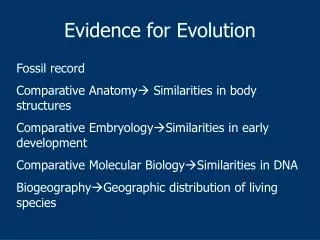
This overview recaps the fundamental concepts and evidence for evolution, illustrating the changes in living organisms since life began on Earth. Key points include the gradual nature of evolution across generations within populations, the significance of genetic changes, and the importance of species interbreeding. It highlights various types of evidence supporting evolution: fossils providing transitional links, anatomical structures revealing common ancestry, embryological similarities, biochemical commonalities across species, and biogeographical distributions showcasing evolutionary adaptations in different regions.

Understanding Evolution: Evidence from Fossils to Biochemical Similarities
E N D
Presentation Transcript
Evidence for Evolution Notes February 15, 2012
Evolution Recap All of the changes that have occurred in living things since the beginning of life on Earth
700 million years ago… MULTICELLULAR ORGANISMS!
Three important points… • Evolution occurs over MANY generations • Evolution occurs within POPULATIONS (NOT individuals) • Evolution involves genetic changes in a SPECIES • (Members of a species interbreed to produce healthy, fertile offspring)
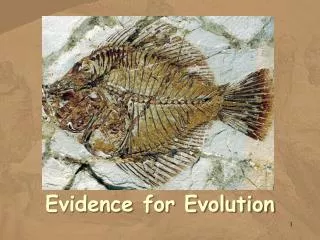
A. Fossils 1.Provides TRANSITIONAL LINKS between species Archaeopteryx: links reptiles and birds Therapsids: mammal-like reptiles
B. Anatomical Evidence • Homologous Structures: structures that are similar because they were inherited from a COMMON ANCESTOR NOTE: similar structure, but NOT always function!
B. Anatomical Evidence (cont.) • Analogous Structures: similar in function, but NOT inherited from a common ancestor NOTE: similar FUNCTION, but not STRUCTURE
B. Anatomical Evidence (cont.) • Vestigial Structures: a body structure that has no function in a present day organism but was probably useful to an ancestor
C. Embryology • Which one is human? • Development of embryos suggests a common ancestor
D. Biochemical Evidence • Almost all living things use the same biochemical molecules • DNA, Protein, ATP • Vast diversity came about by only slight differences in the same genes • The more closely “related” the organisms are, the more similar their DNA
E. Biogeographical Evidence • When we study the distribution of plants and animals on the planet, we notice: • Animals evolved differently in each of the biogeographical regions • We see evidence that as the continents drifted, organisms were separated and evolved.
F. Other Evidence • Mimicry and Camouflage • Antibiotic Resistance