Urinary System
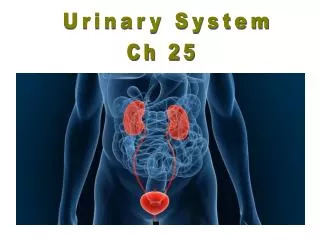
Explore the complexities of the urinary system, from the vital role of the kidneys to the composition and functions of urine. Learn about nephrons, ureters, bladder, urethra, and fluid, electrolyte, and acid-base balance.


Urinary System
E N D
Presentation Transcript
Urinary System Honors Anatomy & Physiology
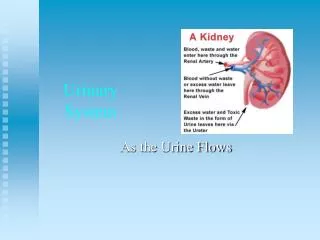
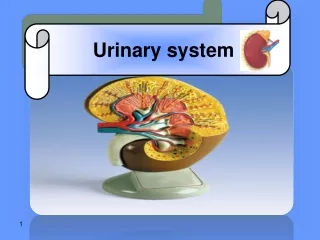
Kidneys • Filter 200L of fluid from blood excreting waste as urine • Regulate blood volume, balance water & salts, pH • Secretes renin (BP) & erythropoeitin (EPO) • Renal Cortex – superficial (light) • Renal Medulla – deeper (dark) arranged in (8) pyramids • Calyces collect urine & empty into renal pelvis
Nephrons • Functional units of kidney • > 1 million per kidney • Glomerulus capillary bed • Fed & drained by arterioles • High pressure forces fluid & soluted out of blood • Peritubular capillaries • From efferent arterioles of glomerulus • Low pressure reclaims solutes & water
Urine • Color • Yellow due to urochrome (pigment from Hb) • Transparent – • cloudy indicator of UTI • Odor • If left out smells of ammonia from bacteria metabolizing urea (diabetics urine smells fruity) • Average pH6 vary (4.5-8) dependent on diet • Composition • 95% water • Urea (from breakdown of amino acids) • Uric acid (from breakdown of nucleic acids) • Creatinine (from creatine phosphate) • Na+, K+, PO43-, SO42-, Ca2+ Mg+2 ,HCO3-
Ureters • Slender tubes propels urine from kidney to bladder • 3 layer wall, transitional epithelium & 2 sheets of smooth muscle for peristalsis
Urinary Bladder • Collapsable muscular sac temporariliy stores urine • Trigone – 3 openings • 3 layers: transitional epithelium, intermingled smooth muscle, fiberous adventitia • Rugae – folds when empty • Full bladder – 5” long – holds 1 pint of urine (max 1L)
Urethra • Drains urine from bladder • Internal urethral sphincter – involuntary • External urethral sphincter – voluntary • Females 3-4” long, external urethral orifice • Males 8” long, carries urine & semen • 3 regions: • prostetic urethra 1” (within prostate) • Membranous urethra 2cm • Spongy urethra 15cm long
Fluid, Electrolyte, & Acid-Base Balance • Water: women 50% of mass, men 60%, infants 73% • Intracellular fluid – in cells • Extracellular fluid – plasma & interstitial fluid (lymph, CSF, eye humors, synovial fluid, etc) • Water intake 2.5L/day & metabolic water • Water output: lung vapors, perspiration, feces, urine • Solutes • Nonelectrolytes – organic molecules w/covalent bonds • Electrolytes – dissociate into ions in water • Ph 7.35 (viens) - 7.45 (arteries) • Buffers: bicarbonate, phosphate, protein