MICROPROGRAMMED CONTROLLER
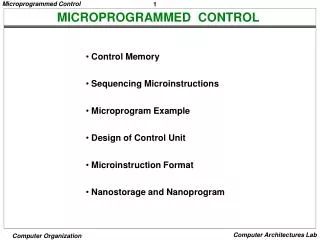
This overview delves into microprogrammed controllers, focusing on their architecture, microinstruction format, and the advantages of implementing ROM-based versus RAM/PROM-based systems. We explore how control signals are generated through state transitions using table look-ups, and the sequential execution of microinstructions. The modular design allows for easier modifications and updates, while our discussion of microinstruction sequencing and timing outlines the intricate processes involved in executing operations. Gain insight into the advantages of a microprogrammable control store in computing systems.

MICROPROGRAMMED CONTROLLER
E N D
Presentation Transcript
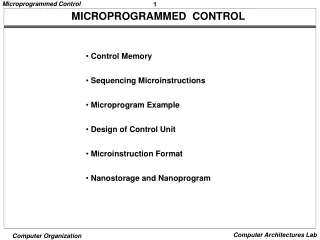
Introduction • Generalization of rom-based controller • State-transition and output functions implemented using Table look-up • Microinstruction • a word in memory specifying • 1. The values of the control signals; • 2. The sequencing information that determines which microinstruction Is executed next • Microprogram - a sequence of microinstructions DSD,USIT,GGSIPU
A Microprogrammed Controller DSD,USIT,GGSIPU
Structure • Control store (CS) - contains the microprogram • Uses ROM,PROM or RAM • Rom-based implementation is permanent; Prom or ram-based Implementations allow modifying the Microprogram) • A ram-based implementation: writable control store • Systems with writable control store called microprogrammable • Control-store address register (CSAR) • Cs address generator (CSAGen) • Decoder - generates control signals • Microcontroller the “control unit" of the Microprogrammed Controller DSD,USIT,GGSIPU
Advantages and disadvantages • The structure of the controller is modular, regular and independent of the particular computation implemented by the system • The implementation of the controller for a complex computation consists of writing the corresponding microprogram • Simpler to write a microprogram than implement a fixed controller • Easily modied • Might be slower DSD,USIT,GGSIPU
Microinstruction format • DIVIDED INTO FIELDS • A CONTROL FIELD: • contains the values of control signals - A SEQUENCING FIELD: • species the address of the next microinstruction DSD,USIT,GGSIPU
Control field • HORIZONTAL (unpacked, decoded) • VERTICAL (packed, encoded) DSD,USIT,GGSIPU
VERTICAL FORMAT • A decoder per subfield • Allocation to subfields • Assigned to the same subfield only if • The operations they control are not required at the same time in the Microprogram; Or • The data subsystem does not allow the simultaneous use of such control Signals. DSD,USIT,GGSIPU
Microinstruction sequencing • Explicit sequencing • Implicit sequencing DSD,USIT,GGSIPU
Implicit sequencing • Two types of control store address calculations required: • INCREMENT CSAR if not a branch, or if the condition not satised • LOAD CSAR with the branch address if the current microinstruction is a Branch and the condition satisfied. DSD,USIT,GGSIPU
Microinstruction timing 1. LOADING THE ADDRESS of the next microinstruction into CSAR. 2. FETCHING (reading) the corresponding microinstruction 3. DECODING the fields. 4. EXECUTING the microoperations. 5. CALCULATING THE ADDRESS of the next microinstruction; this calculation can be overlapped with the execution part of the cycle. DSD,USIT,GGSIPU
Microinstruction Cycle DSD,USIT,GGSIPU