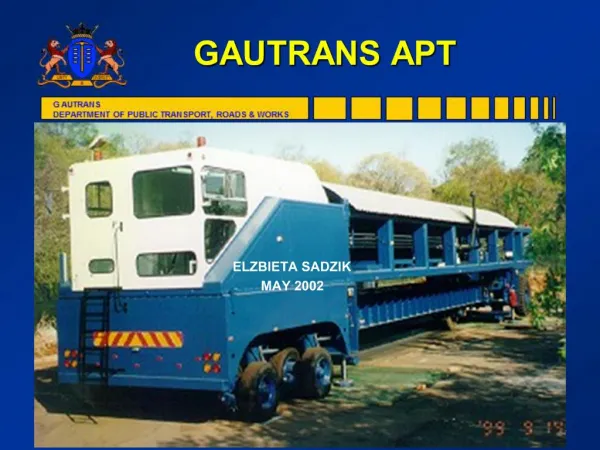
GAUTRANS APT
150 likes | 269 Vues
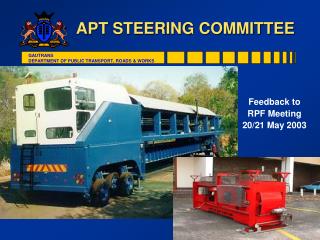
This report provides a detailed cost-benefit analysis comparing the Heavy Vehicle Simulator (HVS) Mark III and Mark IV. Key findings include a 57% decrease in total production costs and a 50% increase in overall production capacity with the HVS Mark IV. Additionally, there are notable improvements in fuel consumption, down time, and load repetition costs. The report outlines testing methodologies and the strategic needs identified by the APT Steering Committee, emphasizing the importance of continued research and development in pavement engineering.


GAUTRANS APT
E N D
Presentation Transcript
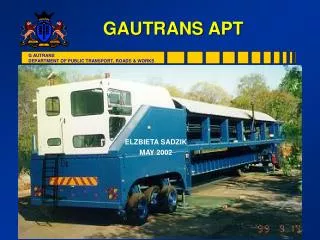
GAUTRANS APT ELZBIETA SADZIK MAY 2002
COST BENEFIT: HVS III vs HVS IV • 57% Decrease in total production cost • 50 % Increase in production • 19% Decrease in Fuel consumption • 56% Decrease in down time
Comparative Cost: HVS III vs HVS IV • HVS Mk III: 80 cents/load repetition • HVS Mk IV+: 50 cents/load repetition
HVS accompanied tests • Laboratory • Standard laboratory • Grading, Atterberg, OMC/MDD (untreated) • CBR, UCS, ITS • Advanced laboratory • Flexural beam test (FBT) • Static and dynamic triaxial (STT and DTT) • Durability • Permeability • Wheel-tracking erosion (WTE) and mechanical brush (MBT)
HVS accompanied tests • Field • HVS • Material characterisation • Field moisture and density, environmental data • Dynamic Cone Penetrometer (DCP) • Deflection, permanent deformation and rut • LTPP • Visual evaluation • Deflections • Traffic survey
HVS management Steering Committee Scope Prioritisation Needs Technical management Guidelines Proposals Reports Technical panel Review Pool
Issues discussed • Unanimous agreement on historical benefit of HVS research for pavement engineering in South Africa and a need to continue • Needs identified: • Long-term research objective • Ad hoc needs (proof testing)
“Steering Committee” identified needs • Cold-mix recycling • Rut-resistant solutions • Ultra-thin & thin concrete layers • Appropriate asphalt overlays & seals • New cement / high UCS layers
“Steering Committee” identified needs • Composite pavements • Cost-effective solutions for low-volume roads • Risk assessment & management • Vehicle-pavement interaction
Proposal • It is proposed that an APT Steering Committee be established as a sub-committee of the RPF