Download
1 / 12
120 likes | 258 Vues
This comprehensive analysis explores the concept of judicial activism within the Canadian legal framework, questioning the balance of power between the judiciary and government branches. By examining fundamental cases such as Chaoulli v. Quebec and the Person’s Case, it highlights how the Canadian Charter of Rights and Freedoms influences judicial interpretation and democracy. The discussion also addresses the evolving objectives of sentencing within the Canadian Criminal Code, including considerations for release, appeals, and the principles guiding judicial actions.

E N D
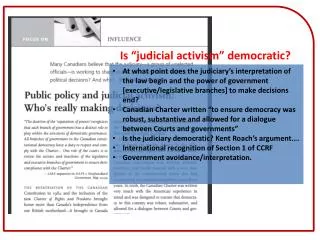
Is “judicial activism” democratic? • At what point does the judiciary’s interpretation of the law begin and the power of government [executive/legislative branches] to make decisions end? • Canadian Charter written “to ensure democracy was robust, substantive and allowed for a dialogue between Courts and governments” • Is the judiciary democratic? Kent Roach’s argument…. • International recognition of Section 1 of CCRF • Government avoidance/interpretation.
Judicial Activism? Chaoulli v Quebec (2005) Person’s Case (1927) Same Sex Marriage (2005)
Sentencing • Guiding Questions • What are the traditional objectives of sentencing? • Are these objectives changing? What is influencing this change? • What are the goals of sentencing per the Canadian Criminal Code? • What sentencing options are available to judges? • What is the appeal process, and for whom? • What is the objective of release? • What are the options for release? Chapter 9
Sentencing: Objectives Restitution Public Safety? Order? Peace? Rehabilitation Retribution
Sentencing: Factors to Consider Page 252
Sentencing: Factors to Consider Criminal Code vs. Charter • Proscribes sentences available for the offense • Subject to political discussion (minimum sentences for gun crimes, no pardons for pedophilic offenses • Everyone has the right not to be subjected to any cruel and unusual treatment or punishment. (Section 12).
Sentencing: Purpose and Principles Deterrence Segregation Rehabilitation Retribution
Sentencing: Purpose and Principles • Proportionality • Mitigating circumstances • Aggravating circumstances • Section 718.2
Sentencing: Options • Community Service • Deportation • Fine • Imprisonment • Capital Punishment • Restorative Justice • Absolute/Conditional Discharge • Suspended Sentence/Probation • Conditional Sentence • Suspension of Privilege • Peace Bond • Restitution/Compensation Page 258
Sentencing: Appeals • Both accused and Crown have the right to appeal sentence. • Votes and reasons/dissenting arguments disclosed. • Results: Change verdict, change sentence, order new trial. • Hierarchy of courts in effect. • Summary offenses • Transcripts, statements of facts reviewed. • Higher court appeals hear arguments. • New evidence only admissible if relevant, credible and impactful. • Question of law (interpretation) or fact (relevance, credibility of evidence) • Indictable offenses • Defense: law, law and fact, fact alone (requires permission), other reason deemed worthy • Crown: law, sentence (requires permission), stay of proceedings or invalid indictment
Looking Ahead • Restorative Justice (Guest Speaker January 13rd- Catherine Bargen) • Corrections System (Guest Speaker January 21st- Sandra Thiessen) • Young Offenders • Seminars: Wrongly accused/convicted, Minorities in the system, Legal Aid, Legal Fees • Comparative Assessments