Overview of CALIPSO Status and Future Plans from Working Group Meeting, June 2009
220 likes | 360 Vues
The CALIPSO Working Group meeting held on June 16-17, 2009, in Wintergreen, VA, highlighted significant achievements and future plans for the mission. The three-year baseline mission was completed, and an extension was approved. A backup laser was activated, improving data acquisition, with over 120 CALIPSO papers published or submitted. Key discussions included the status of laser operation, data processing updates, and new algorithms for both aerosol and cloud profiling, aiming to enhance data quality for better climate modeling.


Overview of CALIPSO Status and Future Plans from Working Group Meeting, June 2009
E N D
Presentation Transcript
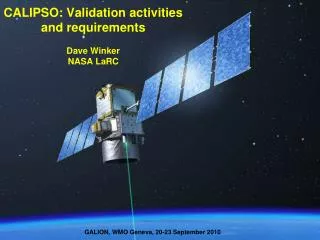
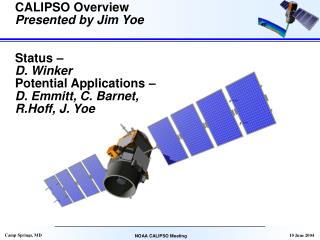
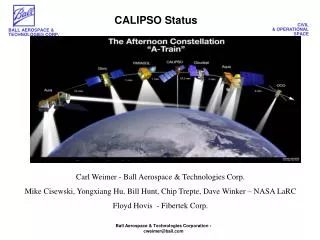
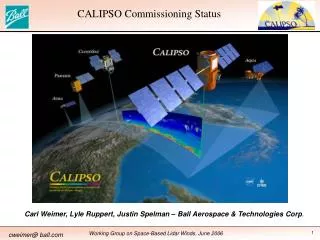
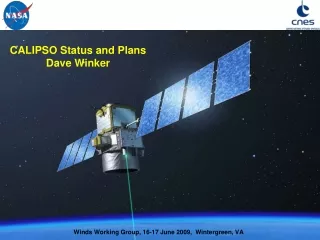
CALIPSO Status and Plans Dave Winker Winds Working Group, 16-17 June 2009, Wintergreen, VA
CALIPSO Highlights • Baseline 3-year mission completed, mission extension approved • Switched to backup laser, March 2009 • Third anniversary of “first light”: 7 June • > 120 CALIPSO papers in print or submitted • JTech special issue on CALIPSO instruments and algorithms • JGR special issue “CALIPSO and the A-train” underway • 35 papers submitted and under review • Joint CP-CS science team meeting, 28-31 July, Madison
CALIPSO Data Used in 47 Countries China USA Japan (as of Sept 2008)
JTech special issue on CALIPSO algorithms • 8 papers now in press • Winker et al., 2009: Overview of the CALIPSO mission and CALIOP data processing algorithms • Hunt, et al. - lidar instrument and performance • Powell, et al.- Lidar 532 nm calibration • Liu, et al. - Cloud and Aerosol Discrimination Algorithm • Young and Vaughan - extinction retrieval algorithm • Vaughan, et al. – layer detection algorithm • Hu et al. - Version 3 I/W phase algorithm • Omar, et al – aerosol typing algorithm • Several more papers underway: • CALIOP detection • IIR and WFC instruments and algorithms
Laser/Data Production Status • LOM-2 turned off 16 Feb 2009 • Laser operation became erratic due to slow pressure leak in canister • LOM-1 turn-on operations commenced, 9 March • Data acquisition with LOM-1 since 12 March • LOM-1 performance as-good or better than initial LOM-2 • LOM-1 pressure holding well (better than predicted) • Data acquired since 12 March has now been processed, to be released soon • Current processing: L1 using Version 3 code, L2 using V2.02
LOM-2 Pulse Energy Trend • 1.61 billion shots on-orbit • energy decreased 6.5% (14.7 mJ) • 10 (out of 192) bar drops over life • no adjustments required adjustment threshold
CALIOP Version 3 Data Products • Current version: 2.02 • Version 3 data products to be released soon • All lidar data from beginning of mission will be reprocessed • Level 1 data • Goal for calibration uncertainty, radiometric stability: 5% • Improved 532 nm daytime calibration • 30 km Rayleigh calibration can only be done at night • Daytime uncertainties improved from 10% to 5% • 1064 nm calibration: significant biases remain • Initial approach using cirrus targets determined to be unreliable • Investigating new approaches (sea surface, etc.) • Version 3 processing of March-May 2009 completed • Level 1 data to be released this week
CALIOP Version 3 Data Products (cont’d) • Level 2 data • New: • particle depolarization, particle color ratio • IWC/IWP, shape parameter (ice), column OD • Uncertainties provided for most parameters • Many bugs fixed • New I/W phase algorithm: adds random and oriented ice • Aerosol and cloud profile products restructured and improved • Aerosol horizontal averaging reduced • Many additional parameters • Data quality information now included
Restructured Profile Products • Version 2 profile products: • Profiles of aerosol and cloud 532 and 1064 extinction and backscatter only • Cloud profiles reported at 5 km • Aerosol profiles averaged to 40 km • Both aerosol and cloud profile products now retrieved at 5-20-80 km and reported at 5-km horizontal resolution • Additional profiles: • 532 nm perpendicular backscatter and particle depolarization • Aerosol/cloud mask • Aerosol/cloud type • Data quality information • CAD score • Ext_QC flag • Feature type QA flags
Boundary layer cloud clearing • In Version 2, clouds below 4 km not cleared properly • Cloud-contaminated aerosol classified as ‘cloud’ • Cloud-clearing scheme fixed in Version 3
Trade cumulus scene V2.01 aerosol cloud V3 (correct) Brian.J.Getzewich@nasa.gov 13
Impact of bug fixes on low cloud distribution Version 2.01 Global mean = 0.456 (low clouds) Version 3, alpha-3 test Global mean = 0.374 (low clouds)
Penetration statistics Global average (single shots) CALIPSO LITE 6 km 58% 90% 4 km 52 85 2 km 43 77 Sfc 31 40 Zonal average penetration frequency (5-km average profiles) CALIPSO LITE orbit 705 km 260 km energy 110 mJ 500 mJ
Version 3 Ice/Water Phase Algorithm Oriented crystals HOI water ice water ROI IAB d (Yong Hu, et al., Optics Express, 2007) (Yong Hu, et al., JTech, 2009)
Reduced artifacts in cloud Ice/Water phase Oriented ice now properly classified (HOI water in V2) Version 2.01 Version 3 Number of ‘ice’ clouds with tops below 3.25 km
I/W phase algorithm: Zonal fraction of ice, water V3 (Aug) V2 (Jan) 19
CALIPSO clouds vs. LMD GCM clouds CALIPSO LMD GCM
CALIPSO provides new tests of model aerosols East Pacific (130-180W) East Asia (110E – 130E) CALIPSO GMAO RAQMS monthly zonal mean extinction (courtesy C. Kittaka)
Looking toward a long-term lidar data record • Potential CALIPSO life through 2012/13 • The WMO-GALION program has recognized that a long-term record from ground lidars is necessary to provide a translation between the CALIPSO and ADM/EarthCare aerosol records • As part of GALION, the EARLINET network has been taking ground-based measurements beginning in July 2006