
Stress Management
E N D
Presentation Transcript
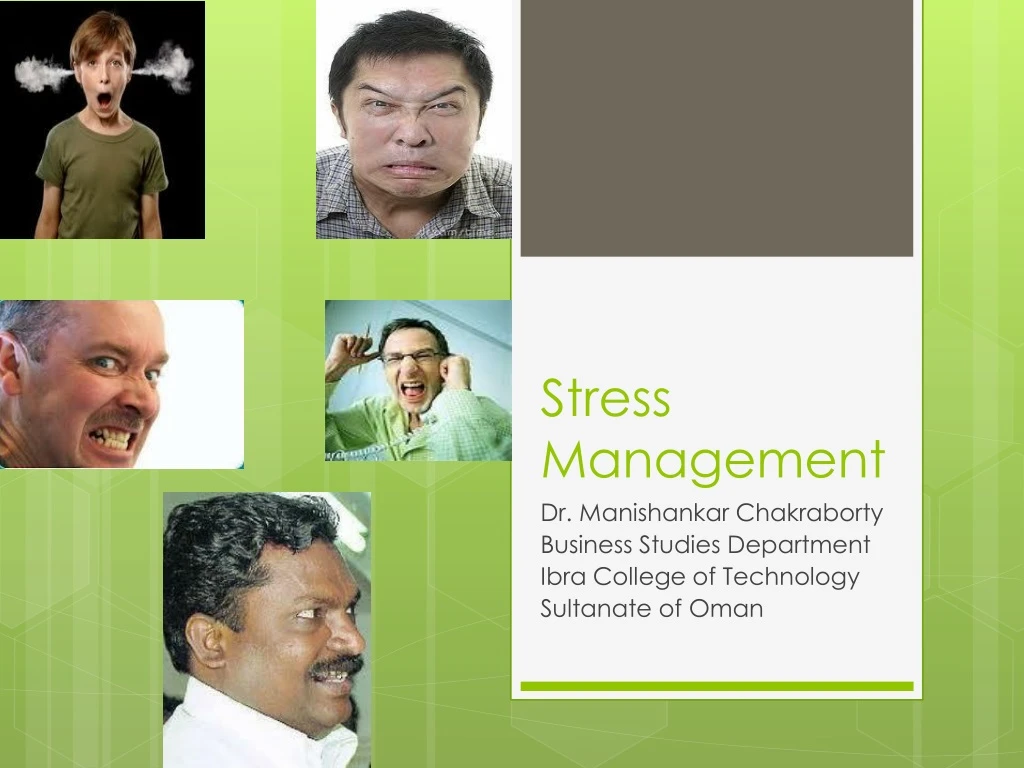
Stress Management Dr. ManishankarChakraborty Business Studies Department Ibra College of Technology Sultanate of Oman
Contents • Watch and Introspect • Introduction • Models • Causes • Common Symptoms • Managing Stress • Simple Stress Management Strategies • Other Techniques to Manage Stress • Stress Scale • Managing a Stress Diary • Importance of a stress Journal • Case-lets for Analysis • References Stress Management,Dr. Manishankar Chakraborty
Watch and Introspect • http://www.youtube.com/watch?v=DknakBGQxL0 Stress Management,Dr. Manishankar Chakraborty
Introduction • Stress is a condition or feeling experienced when a person perceives that "demands exceed the personal and social resources the individual is able to mobilize." (Richard S Lazarus) • Negative stress- Distress, created with events of crisis and having negative consequences • Positive stress- Eustress, created with events having pleasing effect having positive consequences • Stress management comprises of methods/psychotherapies to control the level of stress of a person • Managing stress is about controlling thoughts, emotions, schedule and dealing with problems and issues in life • Identifying stress inducing thoughts, feelings, behavior is not easy Stress Management,Dr. Manishankar Chakraborty
Models • Transactional Model • Richard Lazarus and Susan Folkman (1984) suggested this model. • Stress results from “an imbalance between demands and resources” or “when pressure exceeds one’s perceived ability to cope”. • An effective stress management program should identify the factors central to a person controlling his/her stress and identifying interventional methods effectively targeting these factors. • Health realization/Innate Health Model • Stress does not necessarily follow the presence of a potential stressor. • Focuses on the nature of thought process as it determines the response to potentially stressful external circumstances. • It helps the stressed individual understand the nature of thought while having insecure thinking, disengage from it and access natural positive feelings. Stress Management,Dr. Manishankar Chakraborty
Causes • Professional cause- • Peer, Superior and Subordinate pressure • Meeting deadlines and deliverables • Employer’s expectations • Inability to adapt • Individualistic rather than a team player • Group formations within an organization • Myopic approach • Self-centric • Importing personal issues in the professional front • Negative attitude • Unprofessional behavior • Age • Working environment/culture • Health • Relationships • Personal cause- • Health • Relationships • Many more Stress Management,Dr. ManishankarChakraborty
Common Symptoms • Restlessness • Irritability • Lack of Concentration • Excess sweating • Inability to control ones temper • Lack of patience • Faster heartbeat • Insomnia • Sudden strain in relationships • Stammering • Violent behavior • Negative attitude • Frequent mood swings • Sudden dip in the performance • Headache • Body ache • Depression • Indulging in blame game Stress Management,Dr. Manishankar Chakraborty
Managing Stress • No “One Size Fits All” solution to manage stress • Experimenting with different techniques and strategy is a must • Change the situation • Avoid the stressor • Alter the stressor • Change your reaction • Adapt to the stressor • Accept the stressor Stress Management,Dr. Manishankar Chakraborty
Simple Stress Management Strategies • # 1 Learning to say ‘No’ • # 2 Avoiding people who cause stress • # 3 Taking control of the environment • # 4 Avoiding hot-button topics • # 5 Paring down to do list • # 6 Expressing feelings instead of bottling • # 7 Willing to compromise • # 8 Being assertive • # 9 Managing time better • # 10 Reframing problems • # 11 Looking at the bigger picture • # 12 Adjusting the standards • # 13 Focusing on positive • # 14 Adjusting attitude • # 15 Not trying to control the uncontrollable • # 16 Looking for the upside • # 17 Learning to forgive • # 18 Time for fun and relaxation • # 19 Connecting with others Stress Management,Dr. Manishankar Chakraborty
Simple Stress Management Strategies • # 20 Pursuing hobbies/interests • # 21 Involving in something which brings happiness • # 22 Keeping the sense of humor • # 23 Exercising regularly • # 24 Eating a healthy diet • # 25 Avoiding sugar, coffee, smoking-temporary high • # 26 Getting enough sleep Stress Management,Dr. Manishankar Chakraborty
Other techniques to manage stress(Not to be done without a professional’s supervision) • Autogenic Training • Relaxation technique developed by German psychiatrist Johannes Heinrich Schultz • Daily practice of 15 minutes session during morning, lunch time and evening • The practitioner will repeat a set of visualizations inducing a state of relaxation in postures like lying down, sitting meditation • Cognitive therapy • Psychotherapy developed by American psychiatrist Aaron T. Beck • Patient overcome difficulties by identifying and changing dysfunctional thinking, behavior and emotional responses • Treatment is based on the collaboration between patient and therapist testing beliefs • Meditation • Practice that trains/induces the mind a mode of consciousness to realize some benefit or as an end in itself by building internal energy, love, patience, generosity, compassion and forgiveness. • Yoga Nidra • Conscious awareness of deep sleep state to remove autonomic symptoms of high anxiety like Headache, Giddiness, Chest Pain, Palpitations, Sweating and Abdominal Pain • Deep breathing • Breathing done by contracting the diaphragm(horizontal muscle between chest and stomach cavity) • Air enters lungs and the belly expands and is a complementary and alternative treatment Stress Management,Dr. Manishankar Chakraborty
Stress Scale • Developed by Psychiatrists, Holmes and Rahe(1967) • Surveyed more than 5000 patients on a series of 43 life events for last two years • Each event called as Life Change Unit (LCU) having different weight for stress • More the events, higher is the score and more likely to become ill • 300+ High risk of becoming ill in future • 150-299 Moderate to high chance of becoming ill in the future • Less than 150-Low to moderate chance • Moderate and High level patients should avoid crisis which can be prevented • Stress scale (Click here) • Source- Mindtools • Source- Mindtools Stress Management,Dr. Manishankar Chakraborty
Maintaining a Stress Diary • Helps to understand causes of short term stress • Gives insight to the reaction to stress • Identifying levels of pressure in which one can operate • Analyze different ways and means to manage stress • One should record the following- • Date and Time • Recent stressful event • Subjective assessment on a scale of -10 (most unhappy) and +10 (happiest) • Working effectiveness on a scale of 0(completely ineffective) and 10 (greatest effectiveness) • Fundamental cause of stress • Symptoms • Handling the event Stress Diary (Click Here) • Source- Mind tools Stress Management,Dr. Manishankar Chakraborty
Importance of a stress Journal • Helps to identify regular stressors and way of dealing with them. • It should contain- • (a) What caused the stress? • (b) How one felt, physically and emotionally? • (c) How did one act in response? • (d) What was done to make oneself feel better? Stress Management,Dr. Manishankar Chakraborty
Case-lets for Analysis http://manishankarthetrainer.blogspot.com/2013/02/case-lets-on-stress-management.html From the case-lets, • Identify the causes of stress. • What would you have done to manage the situation? • How is it possible to draw a line between ones personal and professional life? • Complex-Inferior or Superior can lead to stress. Explain with reasons. Stress Management,Dr. Manishankar Chakraborty
Finally, Relax by doing this • http://www.youtube.com/watch?v=aGGHxcrm7FY Stress Management,Dr. Manishankar Chakraborty
References John Kabat-Zinn, 1990, Full Catastrophe Living: Using the Wisdom of Your Body and Mind to Face Stress, Pain, and Illness, Fifteenth edition, Bantam Dell, New York Dr. Frank Lawlis, 2009, Retraining the Brain: A 45-Day Plan to Conquer Stress and Anxiety, Plume, Penguin Group, New York Accessed on 26th January 2013, http://www.helpguide.org/mental/stress_management_relief_coping.htm, Help-guide Accessed on 27thJanuary 2013, http://en.wikipedia.org/wiki/Stress_management, Wiki Accessed on 27th January 2013, http://www.cls.utk.edu/pdf/ls/Week3_Lesson22.pdf , Paper Accessed on 30th January 2013, http://www.mindtools.com/pages/article/newTCS_00.htm, Mind-tools Accessed on 30th January 2013, http://www.mindtools.com/pages/article/newTCS_82.htm, Mind-tools Accessed on 30th January 2013, http://www.mindtools.com/pages/article/worksheets/StressDiary.pdf Mind-tools Accessed on 30th January 2013, http://www.mindtools.com/pages/article/newTCS_01.htm Mind-tools Accessed on 30th January 2013 http://www.mindtools.com/pages/article/albrecht-stress.htm Mind- tools Accessed on 1st February 2013 http://www.youtube.com/watch?v=DknakBGQxL0Video Accessed on 1st February 2013 Accessed on 1st February 2013 http://www.youtube.com/watch?v=aGGHxcrm7FYVideo Accessed on the 1stof February 2013 http://www.manishankarthetrainer.blogspot.com/2013/02/case-lets-on-stress-management.html Blog Stress Management,Dr. Manishankar Chakraborty