Solution Approach for Continuous Flow Stirred Tank Reactor Problem in ChE 479
120 likes | 259 Vues
This document provides a detailed solution to the continuous flow stirred-tank reactor problem for ChE 479. The setup includes a well-mixed tank with an input flow rate of 0.085 m³/min and a volume of 2.1 m³, initially at a concentration of 0.925 mole/m³. It presents the governing equations for a first-order reaction, A → B, with assumptions about constant density, isothermal conditions, and a reaction rate proportional to the reactant concentration. The document outlines the steps to solve the governing differential equation, employing an integrating factor and detailing initial conditions.


Solution Approach for Continuous Flow Stirred Tank Reactor Problem in ChE 479
E N D
Presentation Transcript
Solution to the Continous Flow Stirred-Tank Reactor Problem ChE 479
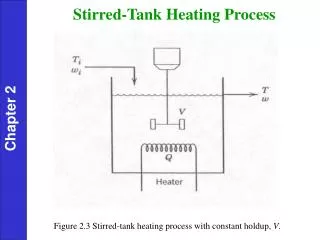
Problem Set-up • The tank is well mixed; • Input flow rate is 0.085 m3/min; • Tank Volume is V=2.1m3; • CAinit = 0.925 mole/m3; • CA0= 0.925 mole/m3; • The system is initially at steady state • A first order reaction is carried out • A--->B • Assumptions: • Density of liquid constant • Reaction rate is proportional to the concentration of the reactant • r = -kCA • Process is isothermal CA(t) CA0
Governing Equations Diving by MWAt and letting t--->0 gives
Initial Conditions Initial Conditions require that we know the concentration of the process output before any perturbation occurred. This means that we must know the output concentration at the previous steady state, when the input concentration was: CA0=Cainit=0.925 mole/m3
Solving the Governing Differential Equation First Order Linear Equation: The genral solution is given by: Is referred to as the Integrating Factor where
Solving the Governing Differential Equation You immediately recognize the this equation is linear and first order ! With And
Solving the Governing Differential Equation So we can calculate the Integrating Factor: Multiple both sides of the governing differential equation Then the right hand is a perfect derivative:
Solving the Governing Differential Equation Now we can integrate the differential equation: But the form of CA0(t) is known. In the example we have discussed it is a constant equal to the value of the input concentration after the perturbation:
Initial Condition The Initial Condition will determine the integration constant: