Nuclear Energy: Power Generation and Safety Considerations
Explore the history, development, and significance of nuclear energy: from fission to fusion, fuel supplies, reactor types and safety measures. Learn about the impact of nuclear energy on industry and society.

Nuclear Energy: Power Generation and Safety Considerations
E N D
Presentation Transcript
Nuclear Energy • most striking development in sources of power in recent years. • Release of the atom
How long….. • Have we known about atomic power?
Ancient Greeks • included atomic theory as one of their philosophical studies • Knowledge about atoms was developed in the 17th century
Early 1900’s • theory became clarified
1940”s • atom was split • resulting power was put to work
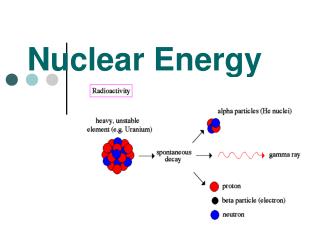
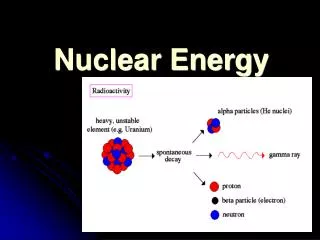
Nuclear fission • the nuclei of heavy atoms are split under bombardment by neutrons
Nuclear fission • when a sufficient amount of fissionable material is brought together • chain reaction occurs
Nuclear fission • splitting atoms and releasing a tremendous amount of heat
Nuclear fission • approximately 20,000 times as much heat and energy is released from uranium fuels as from an equivalent amount of coal
Use of fission power • 1945 • first large scale use • atomic bombs were used by the US to knock Japan out of WWII
WWII • since then attention has been given to the peaceful uses of atomic energy
1980 • the amount of electrical power generated by nuclear power plants was about 11% of the total electrical supplies in the US
Energy from fission • atomic energy in the US today is produced by the process known as nuclear fission
Fuel supplies • adequate supplies for nuclear power • major mineral sources for nuclear power • Uranium 238 • Thorium 232
Fuel • from those - U 235 and Plutonium 239 can be produced • in the early stages of development US relied heavily upon imports of uranium
Fuel • from South Africa and Canada
1950’s and 60’s • western US deposits were developed • Bureau of Mines reported that -
. • “Domestic production is adequate to supply present and near-future domestic requirements.”
In 1981 • US was still the world leading miner of uranium
Nuclear Fusion • Fusion is combining together • the atoms are fused together rather than split apart • possibilities for nuclear fusion are much greater than those for nuclear fission
Fusion • problems • process is so difficult to control that it is questionable whether commercial adaptation will ever be economically feasible
Problems • fusion requires extreme pressure and temperatures • as high as 100 million degrees
Problems • such heat was achieved by the Hydrogen bomb • by first setting off a fission explosion
Fuel for fusion • fusion reactors would be fueled by deuterium • an isotope of hydrogen • available in almost unlimited supply in sea water
US Government • demonstration fusion reactor • hopes to have in operation by 2015
LWR • Light Water Reactor • use ordinary water • have been in commercial use since 1957
LWR • free from environmental problems of coal fired electric power plants
LWR disadvantages • potential of a reactor explosion • contamination form atomic wastes • construction costs and technical problems
Safety? • 1974 report stated of Nuclear Power
Safety? • “its use poses serious environmental issues, including reactor safety, radioactive waste management and nuclear theft……..
Safety? • A very hazardous enterprise.”
Three Mile Island • March 28, 1979 • Human and mechanical failure led to the release of a considerable amount of radioactivity
Three Mile Island • evacuation of preschool children and pregnant women within five miles of the plant
Three Mile Island • Nevertheless • 67 nuclear facilities are expected to continued operating • 90 were planned for construction by 1990
Safety Institutions • two • Nuclear Safety Analysis Center • monitors performance of safety
Safety Institutions • Institute of Nuclear Power • inspects existing reactors and evaluates them
Industrial Significance • peaceful use • development of under-seas and space nuclear power • medical use of radioisotopes
Industrial Significance • research in nuclear physics • ensnarled by many problems technological, economic and social
Breeder Reactors • fast breeder reactors • more efficient to operate than LWR’s are undergoing experiment
Breeder Reactors • two types • LMFBR • Liquid Metal Fast Breeder Reactor
Breeder Reactors • GCFBR • Gas cooled fast breeder reactor
Breeder Reactors • they produce more fuel than they consume • more efficient than LWR’s
Breeder Reactors • can use 50-70% of the uranium mined in contrast to only 2% by the LWR
Breeder Reactors • safety problems for the LMFBR may prove to be more sever than those of the LWR
1950’s • Atomic Energy Commission stated: • all new power plants under construction would be atomic powered
1950’s • nuclear energy would account for one half of all the electricity generated
1950’s forecast • does not seem likely to happen • it takes 10-12 years to get a nuclear plant in operation from the first time it is planned
1950’s forecast • no new plant orders were signed in the early 1980’s due to the Three Mile Island accident.
1974 • American Scientists and Engineers completed a study • assessed the possibilities of accident risks in nuclear reactors…...