Mutations
410 likes | 508 Vues
Explore the world of mutations - changes in DNA sequences that can be beneficial, harmful, or neutral. Discover types of mutations, such as gene and chromosome mutations, and learn about genetic disorders like Down Syndrome and Klinefelter's Syndrome.


Mutations
E N D
Presentation Transcript
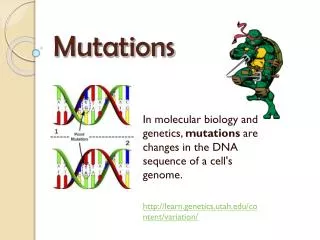
A. What Are Mutations? • Changes in the nucleotide sequence of DNA • May occur in somatic cells – (aka. Body cells) - aren’t passed to offspring • May occur in gametes- (aka. eggs & sperm) can be passed to offspring
B. Are Mutations Helpful or Harmful? • Mutations happen regularly • Mostmutations are neutral and have no major impact • Chemicals & UV radiation cause mutations • Many mutations are repaired by enzymes
Are Mutations Helpful or Harmful? • Some type of skin cancers and leukemia result from somatic mutations • Some mutations may improve an organism’s survival (beneficial); mutations influence evolution by natural selection
1. Gene Mutations • Change in the nucleotide sequence of a gene • May only involve a single nucleotide • May be due to copying errors, chemicals, viruses, etc.
Types of Gene Mutations • Include: • Point Mutations • Substitutions • Insertions • Deletions • Frameshift
Point Mutation • Change of a single nucleotide • Includes the deletion, insertion, or substitution of ONE nucleotide in a gene
Point Mutation • Sickle Cell disease is the result of one nucleotide substitution • Occurs in the hemoglobin gene
Frameshift Mutation • Inserting or deleting one or more nucleotides • Changes the “reading frame” like changing a sentence • Proteins built incorrectly
Frameshift Mutation • Original: • The fat cat ate the wee rat. • Frame Shift (“a” added): • The fat caa tet hew eer at.
Cystic Fibrosis (CF) • Monogenic • Cause: deletion of only 3 bases on chromosome 7 • Fluid in lungs, potential respiratory failure • Common among Caucasians…1 in 20 are carriers • Both parents have to be carriers of the mutated gene.
Chromosome Mutations • May Involve: • Changing the structureof a chromosome • The loss or gain of part of a CHROMOSOME, not a gene
2. Chromosome Mutations • Five types exist: • Deletion • Inversion • Translocation • Nondisjunction • Duplication
Deletion • Due to breakage • A piece of a chromosome is lost
Inversion • Chromosome segment breaks off • Segment flips around backwards • Segment reattaches
Duplication • Occurs when a gene sequence is repeated
Translocation • Involves two chromosomes that aren’t homologous • Part of one chromosome is transferred to another chromosomes
Nondisjunction • Failure of chromosomes to separate during meiosis • Causes gamete to have too many or too few chromosomes • Disorders: • DownSyndrome – three 21st chromosomes • Turner Syndrome – single X chromosome • Klinefelter’s Syndrome – XXY chromosomes
Types of Gene Mutations A B C D E A C D E A B B C D E A C B D E A B H I J F G C D E • Original • Deletion • Duplication • Inversion • Translocation
Karyotype – Used to identify gender and chromosomal genetic disorders
Normal Male 2n = 46
Karyotype Song – To the tune of I wish I had an oscarmeyerwienner. • A karyotype is a picture of condensed chromosomes. • The homologs are paired up and there are 22 autosomes. • Add in a pair of sex chromosomes and take a careful look. • If there is one too many or one too short, a nondisjunction happened and a disorder took.
Normal Female 2n = 46
Male, Trisomy 21 (Down’s) 2n = 47
Symptoms of Down Syndrome • Upward slant to eyes. • Small ears that fold over at the top. • Small, flattened nose. • Small mouth, making tongue appear large. • Short neck. • Small hands with short fingers.
Symptoms of Down Syndrome • Low muscle tone. • Single deep crease across center of palm. • Looseness of joints. • Small skin folds at the inner corners of the eyes. • Excessive space between first and second toe. • In addition, down syndrome always involves some degree of mental retardation, from mild to severe. In most cases, the mental retardation is mild to moderate.
Klinefelter’s Syndrome 2n = 47
Kleinfelter’s syndrome(or Klinefleter’s) • Disorder occurring due to nondisjunction of the X chromosome. • The Sperm containing both X and Y combines with an egg containing the X, results in a male child. • The egg may contribute the extra X chromosome.
XXY • Males with some development of breast tissue normally seen in females. • Little body hair is present, and such person are typically tall, have small testes. • Infertility results from absent sperm. • Evidence of mental retardation may or may not be present.
Turner’s Syndrome 2n = 45
Turner’s • Turner syndrome is associated with underdeveloped ovaries, short stature, webbed, and is only in women. • Bull neck, and broad chest. Individuals are sterile, and lack expected secondary sexual characteristics. • Mental retardation typically not evident. • Chromosomal or monogenic?