
SlideServe
Menu
Préférences
© SlideServe · v2026

Poliomyelitis (Polio)

happy avatar
10 diapositives · 1.2K Views · Jul 18, 2014

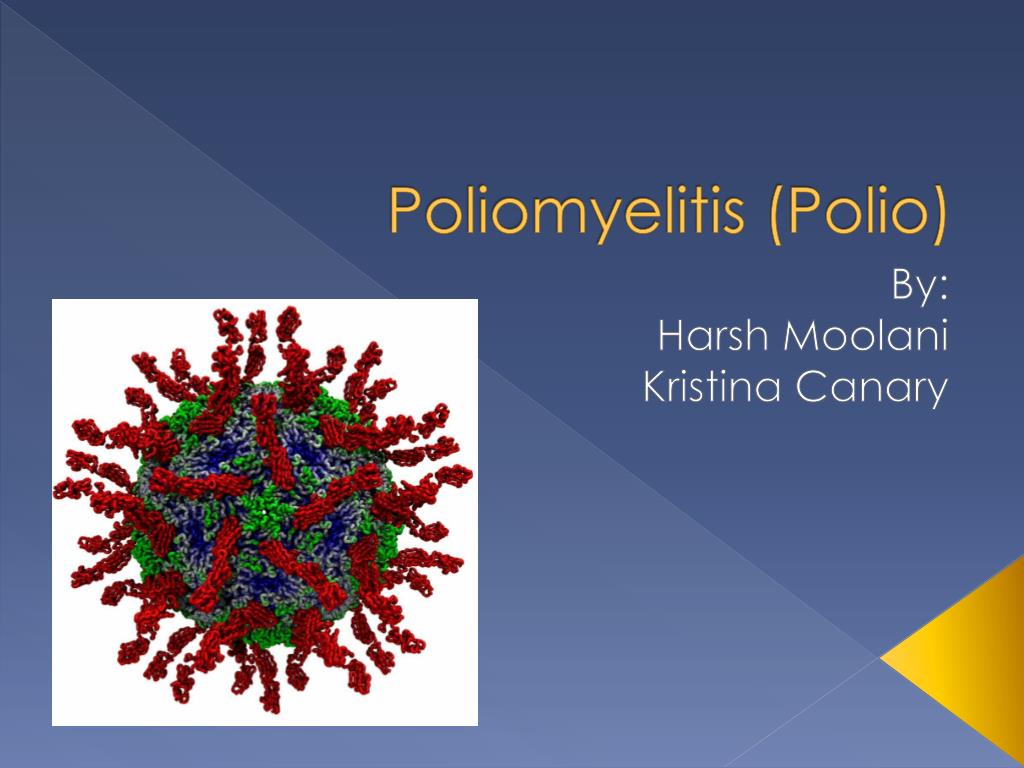
Poliomyelitis (Polio). By: Harsh Moolani Kristina Canary. Viruses . A virus is an infectious , protein coated fragment of DNA or RNA ( Bobick et. al., 2004). Viruses replicate by invading host cells and they take over the cell’s “machinery” for DNA replication ( Bobick et. Al., 2004).
Poliomyelitis (Polio) - slide 1
01 / 10Poliomyelitis (Polio)
1 / 17

Télécharger la présentation

Poliomyelitis (Polio)
Une image / un lien ci-dessous est fourni (tel quel) pour télécharger la présentation

Politique de téléchargement : le contenu du site vous est fourni TEL QUEL pour votre information et votre usage personnel ; il ne peut être vendu, concédé sous licence ni partagé sur d’autres sites sans l’accord de son auteur.Le contenu vous est fourni TEL QUEL, pour votre information et votre usage personnel uniquement. Téléchargez la présentation en cliquant sur ce lien. Lors du téléchargement, si vous ne parvenez pas à télécharger une présentation, l’éditeur a peut-être supprimé le fichier de son serveur.Pendant le téléchargement, si vous ne parvenez pas à obtenir une présentation, le fichier a peut-être été supprimé par l’éditeur.

F I N

Plus de contenu associé

Transcription de la présentation
  1. Poliomyelitis (Polio) By: Harsh Moolani Kristina Canary

  2. Viruses • A virus is an infectious , protein coated fragment of DNA or RNA (Bobick et. al., 2004). • Viruses replicate by invading host cells and they take over the cell’s “machinery” for DNA replication (Bobick et. Al., 2004). • Viruses include small pox, pertussis, yellow fever, chicken pox, HIV, measles, and polio.

  3. Transmission • Polio can be transferred in multiple ways and some include: • Direct person-to-person contact (NCBI, 2012) • Contact with mucus or saliva from the nose or mouth (NCBI, 2012) • Contact with infected feces (NCBI, 2012)

  4. Symptoms • General discomfort • Headache • Red throat • Slight fever • Sore Throat • Vomiting (PubMed, 2013) • Paralysis

  5. Prevalence • Prevalence with polio has fallen over 99% since 1988 (PubMed, 2013) • Only 3 world countries are polio endemic worldwide (Pakistan, Afghanistan, and Nigeria

  6. Prevention • The polio vaccine which has prevented over 90% of the polio virus (PubMed, 2013) • Don’t associate with a polio carrier • Don’t have contact with feces, or the mucus of the infected individual

  7. Treatment • Antibiotics for urinary tract infections • Moist heat to reduce muscle pains and spasms (PubMed, 2013) • Painkillers to reduce headache, pain, and spasms • Physical therapy, braces, corrective shoes, or orthopedic surgery to help recover muscle strength and function

  8. Social Impact • Over the past two decades, tremendous progress has been made toward the eradication of polio. (Bill Gates Foundation, 2012) • The polio virus was endemic in 125 countries and about 350,000 people, primarily young children, were annually paralyzed.

  9. Economic Impact • Once polio is eradicated, the world can celebrate public good that will benefit all people everywhere in the world • Eradicating polio in the next five years would save at least $40–50 billion (WHO, 2012)

  10. Sources • BillGatesFoundation. (2012). Polio. [accessed 11 March 2013]. Retrieved from http://www.gatesfoundation.org/What-We-Do/Global-Development/Polio • Worldhealthorganization. (2012). Poliomyelitis. [accessed 11 March 2013]. Retrieved from http://www.who.int/mediacentre/factsheets/fs114/en/ • PubMed Health. (2013). Poliomyelitis. [accessed 11 March 2013]. Retrieved from www.ncbi.nlm.nih.gov/pubmedhealth/PMH/0002375/ • Bobick, J., Balban, N., Bobick, S., & Roberts, L. B. (2004). The Handy Biology Answer Book. Canton, MI: Visible Ink Press.