Addressing Market Failures and Enhancing Environmental Stewardship through Policy Reform
This text examines the role of policy in combating market failures, especially concerning environmental sustainability. It discusses the importance of regulatory frameworks, incentives, and legislation to ensure the provision of non-market goods and services. The document raises critical questions about how much society is willing to pay for environmental services, identifies challenges like the free-rider problem, and explores potential solutions such as promoting environmental stewardship clubs and better information dissemination. The ultimate goal is to align citizen preferences with actual spending on environmental initiatives.

Addressing Market Failures and Enhancing Environmental Stewardship through Policy Reform
E N D
Presentation Transcript
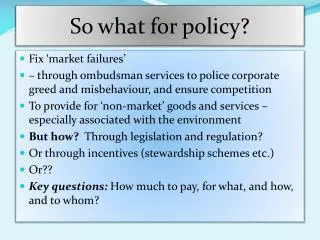
So what for policy? • Fix ‘market failures’ • – through ombudsman services to police corporate greed and misbehaviour, and ensure competition • To provide for ‘non-market’ goods and services – especially associated with the environment • But how? Through legislation and regulation? • Or through incentives (stewardship schemes etc.) • Or?? • Key questions: How much to pay, for what, and how, and to whom?
How much? Citizens “vote” for more/ better ES. ‘cheap talk’ – markets working? Won’t pay the price? Marketsworking Y Consumers buy more ES? Y N A thought experiment – supposing that we had ‘reliable’ data on Votes, WTP and actual spending on ES, would we expect these three to say the same thing?
How much? Citizens “vote” for more/ better ES. ‘cheap talk’ – markets working? Won’t pay the price? Marketsworking Y Consumers buy more ES? Y N N Others don’t (free rider problem)? Y Free rider deficit > market deficit? Free-Rider deficit: the difference between the sum of individual WTPs and the sum of WTPs conditional on other people also paying for ES. Market deficit: the cost of providing the (additional) ES. N Marketsworking
How much? Citizens “vote” for more/ better ES. ‘cheap talk’ – markets working? Won’t pay the price? Marketsworking Y Consumers buy more ES? Y N N Others don’t (free rider problem)? Y Free rider deficit > market deficit? N Y Marketsworking Encourage/Promote ES clubs OR, as a last resort, subsidise consumption of Env. friendly products
How much? Citizens “vote” for more/ better ES. ‘cheap talk’ – markets working? Won’t pay the price? Marketsworking Y Consumers buy more ES? Y N N N N Labels are unreliable? Info. is inadequate? Others don’t (free rider problem)? Y Y Y Free rider deficit > market deficit? Improve 3rd party validation Improve Info. & Comm. Systems N Y Marketsworking Encourage/Promote ES clubs OR, as a last resort, subsidise consumption of Env. friendly products
How much? Citizens “vote” for more/ better ES. ‘cheap talk’ – markets working? Won’t pay the price? Marketsworking Y Consumers buy more ES? Y N N N N N N Labels are unreliable? Info. is inadequate? Others don’t (free rider problem)? Other things more important? Too much effort? Y Y Y Y Y Y Free rider deficit > market deficit? Improve 3rd party validation Improve Info. & Comm. Systems N Y Marketsworking Marketsworking Marketsworking Encourage/Promote ES clubs OR, as a last resort, subsidise consumption of Env. friendly products