Arctic System Reanalysis: Integrating Observations for Environmental Change Monitoring
The Arctic System Reanalysis aims to consolidate available observations into a coherent framework for monitoring environmental changes in the Arctic. By integrating atmospheric, sea ice, upper ocean, and land hydrology data, this initiative facilitates a deeper understanding of significant variations observed over the past decade. Early experimental work using the Polar MM5 model, currently transitioning to the NCEP WRF system, emphasizes the importance of resolving Arctic processes and enhancing data assimilation strategies for improved forecasting and climate assessments.

Arctic System Reanalysis: Integrating Observations for Environmental Change Monitoring
E N D
Presentation Transcript
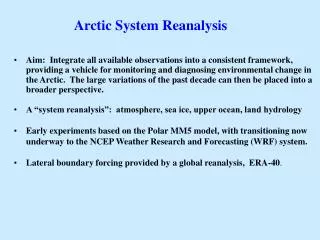
Arctic System Reanalysis • Aim: Integrate all available observations into a consistent framework, providing a vehicle for monitoring and diagnosing environmental change in the Arctic. The large variations of the past decade can then be placed into a broader perspective. • A “system reanalysis”: atmosphere, sea ice, upper ocean, land hydrology • Early experiments based on the Polar MM5 model, with transitioning now underway to the NCEP Weather Research and Forecasting (WRF) system. • Lateral boundary forcing provided by a global reanalysis, ERA-40.
Primary activities to date: • Parameterization experiments targeting Arctic processes -- surface parameterizations (sea ice, terrestrial Arctic) -- PBL (strongly stable) -- Arctic clouds, radiative interactions • Evaluation of global reanalyses (ERA-40, NCEP) over Arctic • Tests of different data assimilation strategies
Precipitation over Iceland from Polar MM5 Observed annual mean precipitation (mm) derived from station data, contour interval = 200 mm Annual mean precipitation, 1991-2000 derived from polar MM5 V3.5 (cm). Contour interval = 20 cm. MM5 is driven at the boundaries by ECMWF operational analyses. Courtesy of D Bromwich, Ohio State University
Some findings to date: • Accuracy of regional reanalysis depends more strongly on resolution than on choice of assimilation strategy • Data-driven increments in the Arctic are large (several ºC, mb) • TOVS data have major impact on global reanalysis (ERA-40) in Arctic
January 1993, 500 hPa Height Difference for ERA40 with and without TOVS/HIRS Images courtesy Per Kallberg, European Centre for Medium-Range Weather Forecasts
Near-term to long-term plans: • Diagnosis of North American regional reanalysis in Arctic • SHEBA year (1997-98) to be run as prototype with enhanced WRF • Optimum use of satellite data (e.g., TOVS) • Interface with future global reanalysis of NCEP • Integration of sea ice, terrestrial, upper ocean components • International partners, additional agency partners