The Evolution and Functionality of V8 Engines: A Detailed Overview
This presentation delves into the history and mechanics of the V8 engine, tracing its origins back to the Otto cycle, developed by Nicolaus Otto in 1876. By using a V-shape design, engineers achieved a powerful and efficient engine suitable for modern automobiles. Our model features a ¼ scale replica with operational valves, a moving piston, and a functional fan, showcasing the intricacies of a 16-valve pushrod cylinder block. We also discuss design improvements and the complexities involved in the assembly and animation process of the V8 engine.

The Evolution and Functionality of V8 Engines: A Detailed Overview
E N D
Presentation Transcript
V-8 Engine Group 3 Javier Remotti Brent Peterson Viral Shah Mehul Photographer Luigi Balarinni
Internal Combustion Cycle • Four cycle process • Intake • Compression • Expansion • Exhaust • Known as Otto Cycle • Developed by Nicolaus Otto in 1876.
History of the V8 Engine • Automobile manuf. wanted more power. • Achieved by more cylinders. • A straight-8 was deemed too heavy and long to fit in ordinary vehicles. • Led to the design of the V-shape, which allowed for a greater power to weight ratio.
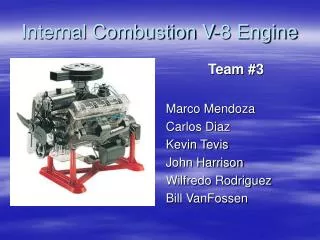
Our Model • The model used is a ¼ scale replica. • Features: • Operating Valves • Moving piston • Functional Fan • 16 valve push rod
Cylinder Block • Most complicated part of the engine. • Attaches cylinder heads, crankcase, engine mounts, drive housings, engine ancillaries. • Made of Aluminum with cylindrically bored holes.
Crankshaft • Translates linear piston motion into rotation. • Can be forged or cast from iron • Connects to the flywheel to reduce the pulsation motion of the four stroke cycle.
Camshaft and Valves • Cams force the push rods to open and close the valves. • Valves are used to open and close the intake and exhaust ports in the cylinder heads.
Design Improvements • Make the exhaust manifold streamlined for better flow of air. • Replace Push rod system with Dual Overhead Camshaft system. (DOHC)
Difficulties • 48 Valve/Rocker/Cam connections • Complex protrusions • Difficulties in measuring parts • Tolerances lead to difficulties in assembly • The number of parts made the animation process slow and tedious