1 / 35

An Introduction to Conceptual Art: Understanding Its Significance in Art History

This brief introduction explores the essence of conceptual art, emphasizing the idea or concept as the core element of a work. In conceptual art, artists prioritize premeditated planning and decision-making over the physical execution, treating it as a secondary task. The concept itself functions as a driving force, shaping the final piece. Citing Sol LeWitt's influential work in 1967, we delve into how conceptual art redefined artistic practices and continues to influence contemporary art.

haroun
Télécharger la présentation

An Introduction to Conceptual Art: Understanding Its Significance in Art History

An Image/Link below is provided (as is) to download presentation Download Policy: Content on the Website is provided to you AS IS for your information and personal use and may not be sold / licensed / shared on other websites without getting consent from its author. Content is provided to you AS IS for your information and personal use only. Download presentation by click this link. While downloading, if for some reason you are not able to download a presentation, the publisher may have deleted the file from their server. During download, if you can't get a presentation, the file might be deleted by the publisher.

E N D

Presentation Transcript


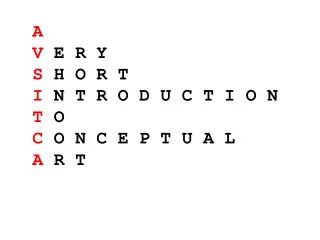
  1. A V E R Y S H O R T I N T R O D U C T I O N T O C O N C E P T U A L A R T

  2. N O W E V E N T S A R T H I S T O R Y

  3. In conceptual art the idea or concept is the most important aspect of the work. When an artist uses a conceptual form of art, it means that all of the planning and decisions are made beforehand and the execution is a perfunctory affair. The idea becomes amachine that makes the art. Sol LeWitt, "Paragraphs on Conceptual Art", Artforum, June 1967


More Related