Download
1 / 34
340 likes | 451 Vues
This overview examines the American role in the Vietnam War from 1945 to 1973, highlighting the transition from post-World War II aid to the French in their conflict against the Viet Minh to the full-scale military engagement in the 1960s. It discusses the strategies employed, including the use of advisors, air campaigns, and ground forces, as well as pivotal events like the Gulf of Tonkin Incident and the Tet Offensive. The analysis also reflects on the shifting public perception and policy changes during the war, ultimately leading to America’s withdrawal and the fall of South Vietnam.

E N D
Vietnam War Military History
American Role 1945-54 • Observer • Gave French aid against Vietminh • Part of strategy to fight communism • By 1954—US pays 80% of cost • French ask for assistance-US refuses
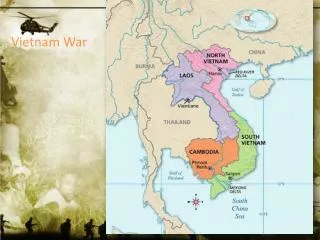
Geneva Agreement • 1954 • Laos and Cambodia made independent • Vietnam divided • Elections in 2 years • North under control of Ho Chi Minh • South—Diem • South refuses to hold elections in 1956
Problems with South • Never a “true nation”—artificial construct • Diem sets up dictatorship • Attacks enemies • Catholic minority given favored positions • Never has support of people in South • Insurgency starts—initially not control by North • US sends in advisors
Advisor Stage • Initially advise ARVN to fight “American style” • President Kennedy sends LBJ to investigate situation in Vietnam. • Sends in more “advisors” • Up to 16,000 helping the Vietnamese • Massive influx of technology • Helicopters, tanks, aircraft
John Paul Vann • Advisor in 1962 • Counter-insurgency skills • Becomes frustrated with ARVN • Battle of Ap Bac • Lack of assertiveness of ARVN • Reply on artillery and firepower • Allow enemy to escape • Vann attempts to report problems • Ignored—leadership only reports success • Goes to Press—NY Times
Gulf of Tonkin Incident (1964) • US Navy doing surveillance of North • Same time secret CIA missions in North • N. Vietnam does not realize difference • Attack USS Maddox • 3 days later—repeat attack • Many question if attack really happened
American Response • Turning Point • Johnson not completely honest with public • G of T resolution written, waiting for right moment • Mistake-- obtain Declaration of War?
Americanization • Limited War • Limited manpower • Limited goals • Allow S. Vietnam to exist without communist intervention • Probably impossible to accomplish • War of Attrition • Kill more than enemy can field • Bodycounts important
Westmoreland asks for more troops • American public told that victory is close
Air War • Rolling Thunder—drop more tonnage than WWII • More in South than North • Gradualism • Controlled in Washington • Hanoi, Haiphong harbor, Chinese border off limits • Problem-few suitable targets for strategic bombing
Different Result? • JCS drew up list of 94 targets in 1965 • Claimed it would knock North out of the war in 2 weeks. • Most targets were on off-limits list
Change in Air War • Late in War--Negotiation strategy • Linebacker I • Force NV to negotiate • Linebacker II • Break negotiations impasse • Most restraints removed • Very effective—high losses of B-52s
Naval Role • Significant Role 1965-68 • Fire support—use of carriers and battleships • Interdiction of supplies • Operation Market Time • Stop coastline resupply of VC • Riverine Warfare • Control the rivers—Mekong River • Generally successful
Tet Offensive • Turning Point of war • Seemingly impossible major attack • Hit urban areas • Crushed—VC basically destroyed as force • Politically- US defeat, NV victory • Role of media-Walter Cronkite • Johnson begins to have doubts • Halts bombing, stops troop increases
My Lai Massacre • Attack by American troops on unarmed women and children • Area of known heavy VC activity-”pinkville” • Charlie Company recently lost popular Srgt. • Killed over 400 Vietnamese • Cover-up –revealed by NY Times • Came to be a symbol of American actions in Vietnam • Blow to military credibility
Change in policy • Westmoreland asks for 200,000 more troops • Johnson’s advisors start to tell him the war is unwinnable. • Recommend disengagement • Johnson leaves big issues for Nixon to resolve in 1969 • Nixon claims to have “secret plan”
Failed American Strategy • Depended heavily on search and destroy missions • Depended on sophisticated surveillance and heavily armed patrols to locate enemy • Then destroy with airstikes, artillery and air cavalry • Need for repeated sweeps • Hard to identify enemy—high civilian losses
Vietnamization • US slowly withdraws • Turns over equipment to ARVN • Nixon Administration decides to walk away • Negotiations with North Vietnamese
Secret War in Cambodia • Nixon began to bomb communist bases in neutral Cambodia. • April, 1972 American and Vietnamese forces invade Cambodia • Hope to cut North Vietnamese supply lines • Failed to achieve its goal • Destabilizes the Cambodian government • Massive protest in America—appears to be expansion of war
End is near • 1972-NV launches major offensive • Smashes SV forces • US bombs North-nothing else • Early in 1973, negotiated settlement reached • SV government in place • Allowed VC and NVA in control of parts of South
End • January 1973-last American combat soldier leaves South • March 1975-North launches another offensive • US fails to help • North wins
Cost of War • Military, social and political disaster • 58,000 Americans killed • 3-4 million Vietnamese • Cost of war estimated at $100 billion • Nonmonetary costs much higher • Undermined confidence in American institutions