SlideServe
Menu
Préférences
© SlideServe · v2026

Bellwork Write an algebraic expression for each verbal expression.

harveyb avatar
19 diapositives · 251 Views · Jan 02, 2020

Learn about integers, their properties, and how to perform operations with them. Explore algebraic expressions and solve problems involving addition, subtraction, multiplication, and division of integers.
Bellwork Write an algebraic expression for each verbal expression. - slide 1
01 / 19Bellwork Write an algebraic expression for each verbal expression.
1 / 17

Télécharger la présentation

Bellwork Write an algebraic expression for each verbal expression.
Une image / un lien ci-dessous est fourni (tel quel) pour télécharger la présentation

Politique de téléchargement : le contenu du site vous est fourni TEL QUEL pour votre information et votre usage personnel ; il ne peut être vendu, concédé sous licence ni partagé sur d’autres sites sans l’accord de son auteur.Le contenu vous est fourni TEL QUEL, pour votre information et votre usage personnel uniquement. Téléchargez la présentation en cliquant sur ce lien. Lors du téléchargement, si vous ne parvenez pas à télécharger une présentation, l’éditeur a peut-être supprimé le fichier de son serveur.Pendant le téléchargement, si vous ne parvenez pas à obtenir une présentation, le fichier a peut-être été supprimé par l’éditeur.

F I N

Plus de contenu associé

Transcription de la présentation
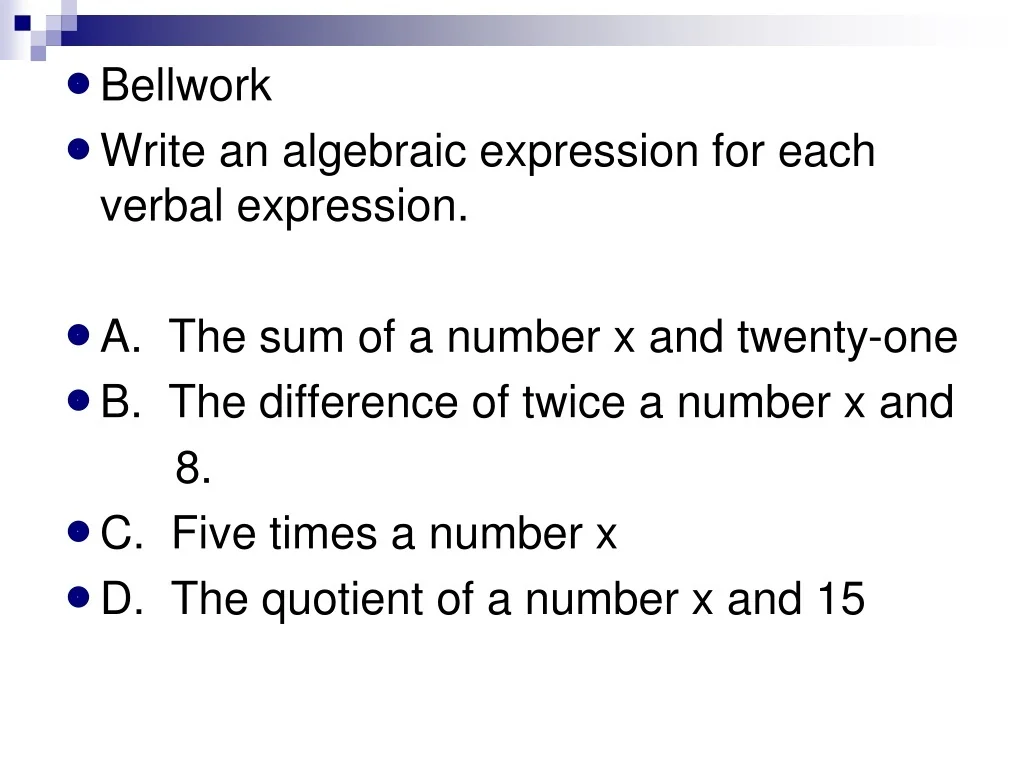
  1. Bellwork • Write an algebraic expression for each verbal expression. • A. The sum of a number x and twenty-one • B. The difference of twice a number x and 8. • C. Five times a number x • D. The quotient of a number x and 15

  2. Operations with Integers

  3. What is an Integer? • A whole number that is either greater than 0 (positive) or less than 0 (negative) • Can be visualized on a number line:

  4. What is a Number Line? • A line with arrows on both ends that show the integers with slash marks • Arrows show the line goes to infinity in both directions ( + and -) • Uses a negative sign (-) with negative numbers but no positive sign (+) with positive numbers • Zero is the origin and is neither negative nor positive

  5. What are Opposites? • Two integers the same distance from the origin, but on different sides of zero • Every positive integer has a negative integer an equal distance from the origin • Example: The opposite of 6 is -6 • Example: The opposite of -2 is 2

  6. What is Absolute Value? • Distance a number is from zero on a number line (always a positive number) • Indicated by two vertical lines | | • Every number has an absolute value • Opposites have the same absolute values since they are the same distance from zero • Example: |-8| = 8 and |8| = 8 • Example: |50| = 50 and |-50| = 50

  7. What Can We Do to Integers? • Integers are numbers, so we can add, subtract, multiply, and divide them • Each operation has different rules to follow

  8. Adding Rules – Same Signs • If the integers have the SAMEsigns: ADD the numbers & keep the same sign! • Positive + Positive = Positive Answer • Negative + Negative = Negative Answer • Examples: -3 + (-10) = ? ? = -13 • 6 + (8) = ? ? = 14

  9. Adding (Same Signs) - Examples #1. -3 + (-10) Step 1:13 Add the #s Step 2: -13 Keep same sign (Both #s are negative – Answer is negative!) #2. 6 + (8) Step 1:14 Add the #s Step 2: 14 Keep same sign (Both #s are positive – Answer is positive!)

  10. Adding Rules – Different Signs • If the integers have the DIFFERENT signs: SUBTRACT the numbers & use sign of the BIGGERnumber! • Bigger # is Positive = Positive Answer • Bigger # is Negative = Negative Answer • Examples: -13 + (7) = ? ? = -6 • 23 + (-8) = ? ? = 15

  11. Adding (Different Signs) - Examples #1. -13 + (7) Step 1:6 Subtract the #s Step 2: -6 Use sign of bigger # (Bigger # is negative - Answer is negative!) #2. 23 + (-8) Step 1:15 Subtract the #s Step 2: 15 Use sign of bigger # (Bigger # is positive - Answer is positive!)

  12. Subtracting Rules • Put ( ) around second number & its sign • ChangeSUBTRACTION sign to an ADDITION sign • Change sign of 2nd number to itsopposite • Follow the rules forADDITION: -SAME signs: Add & keep the same sign -DIFFERENT signs: Subtract & use sign of bigger # • Examples: -5 – -10= ? ? = 5 • 9 - 23 = ? ? = -14

  13. Subtracting - Examples #1. -5 – -10 #2. 9 - 23 Step 1:-5 – (-10)Insert ( ) 9 – (23) Step 2: -5 + (-10) Change – to + 9 + (23) Step 3: -5 + (10) Change 2nd sign 9 + (-23) Step 4:5 Follow adding rules -14d

  14. Multiplying Rules • Multiply the numbers like usual • If the integers have the SAMEsigns: ANSWER will be POSITIVE • If the integers have DIFFERENTsigns: ANSWER will be NEGATIVE • Examples: -3 · (-5) = ? ? = 15 • -9 · (-10) = ? ? = 90 • -7 · 7 = ? ? = -49 • 6 · -6 = ? ? = -36

  15. Multiplying - Examples • #1. -3 · (-5) #2.-9 · (-10) • 15 Multiply the numbers 90 • 15Same signs = Positive Answer 90 #3. -7 · 7 #4.6 · -6 49Multiply the numbers 36 -49 Different signs = Negative Answer-36

  16. Dividing Rules • Divide the numbers like usual • If the integers have the SAMEsigns: ANSWER will be POSITIVE • If the integers have DIFFERENTsigns: ANSWER will be NEGATIVE • Examples: -33 ÷ (-3) = ? ? = 11 • -90 ÷ (-10) = ? ? = 9 • -20 ÷ 2 = ? ? = -10 • 6 ÷ -6 = ? ? = -1

  17. Dividing - Examples • #1. -33 ÷ (-3) #2.-90 ÷ (-10) • 11 Divide the numbers 9 • 11Same signs = Positive Answer 9 #3. -20 ÷ 2 #4.6 ÷ -6 10 Divide the numbers 1 -10 Different signs = Negative Answer-1

  18. Mixed Practice Solve the following problems: -9 + - 9 7 · -4 -10 - (-19) -35 ÷ -7 15 + -25 -23 - 9

  19. Review • Visit the website below for additional information on integers: http://www.math.com/school/subject1/ lessons/S1U1L10GL.html