DISTRIBUTED COMPUTING
This comprehensive guide delves into the fundamental concepts of remote communication in distributed computing. Covering Remote Procedural Calls (RPC), this text addresses key topics such as RPC implementation, communication protocols, server management, and client-server binding processes. It explores varying invocation semantics, exception handling, and RPC optimization techniques. Through case studies including Sun RPC, readers will gain a deep understanding of both basic and complicated RPC issues within heterogeneous environments, alongside practical approaches to enhance efficiency and reliability in remote communication.

DISTRIBUTED COMPUTING
E N D
Presentation Transcript
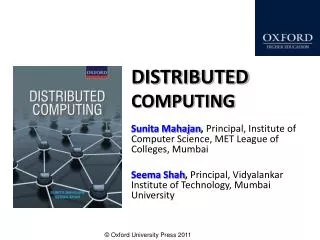
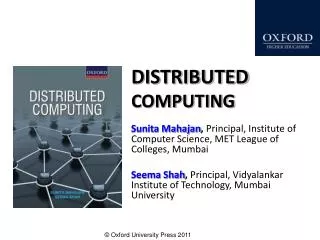
DISTRIBUTED COMPUTING Sunita Mahajan, Principal, Institute of Computer Science, MET League of Colleges, Mumbai Seema Shah, Principal, Vidyalankar Institute of Technology, Mumbai University
Topics • Introduction to Remote Communication • Remote Procedural Call Basics • RPC Implementation • RPC Communication • Other RPC Issues • Case Study: Sun RPC • Remote invocation Basics • RMI Implementation
Introduction • Middleware
Remote Procedure Call • Basic RPC operation
Elements of RPC mechanism implementation • Client • Client stub • RPC Runtime • Server stub • Server
Stub generation • Manual generation • Auto generation using Interface Definition Language (IDL)
RPC implementation • RPC messages: • Call / Request • Reply
Parameter Passing Semantics • Call-by-value semantic • Marshalling • Call-by –reference semantic • Call-by-copy/restore semantic Call-by-value copies all parameters into a message before transmission . Call-by-reference passes pointers to the parameters that are passed from the client to the server. Call-by-copy/restore uses temporary storage accessible to both programs
Server management • Server implementation • Stateless server • Stateful server • Server management • Instance per call • Instance per session • Persistent servers
RPC communication • RPC call semantics
Orphan calls • Calls whose caller has expired due to a node crash • Handle orphan calls by using: • Extermination • Reincarnation • Gentle reincarnation • Expiration
RPC communication protocols • Request protocol • Request/Reply protocol • Request/Reply/ Acknowledge- Reply protocol
Client Server binding • Issues • Server naming • Server locating • Binding agent primitives • Register • Deregister • Lookup • Types of binding • Fixed binding • Dynamic binding • At compile time • At link time • At run time
Other issues in RPC implementation • Exception handing and security • Failure handling • Optimizing RPC execution • Various types of complicated RPCs
RPC in heterogeneous environment • Data presentation • Transport protocol • Control protocol
Failure handling mechanism in RPC • Client cannot find the server • Request from client to the server is lost • Reply from server to the client is lost • Server crashes after getting the request • Client crashes after sending the request
Concurrent access to multiple servers • Use of threads • Early reply technique • Call buffering approach • Serving multiple requests simultaneously • Reducing call workload of server • Using reply cache for idempotent RPC
Complicated and special RPCs • Complicated RPCs • RPCs with long duration calls or with gaps between calls • RPCs with long messages • Special RPCs: • Call back RPC • Broadcast RPC • Batch mode RPC
Call back RPC • Client handle is provided to the server • Client process should wait for callback RPC • Handle callback deadlocks
Case Study- Sun RPC • Uses rpcgen compiler which generates • Header file • XDR filter file • Client stub file • Server stub file
Remote Object Invocation • Distributed object concept • Remote objects reference • Remote interface
RMI implementation Design issues in RMI • RMI invocation semantics • Level of transparency • Marshalling • Message passing • Task of locating and contacting the remote object for the client • RMI invocation semantics • Maybe semantics • At-least-once semantics • At-most-once semantics