Download
1 / 17
170 likes | 314 Vues
This presentation by Nicholas D. Lane, Hong Lu, Shane B. Eisenman, and Andrew T. Campbell, led by Pete Clements, explores cooperative techniques to improve sensor-based applications for user-centric experiences. The discussion encompasses projects like MetroSense and CenceMe, details on data sharing methods, and the integration of opportunistic feature vector merging within social networks. The proposed approach leverages diverse sensor capabilities through collaboration among users, addressing challenges in training data scarcity, privacy concerns, and model accuracy, ultimately aiming for a more effective data-driven personalization.

E N D
Cooperative Techniques Supporting Sensor-based People-centric Inferencing Nicholas D. Lane, Hong Lu, Shane B. Eisenman, and Andrew T. Campbell Presenter: Pete Clements
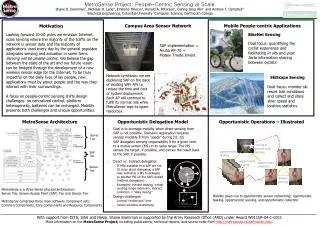
Background • MetroSense • Andrew T. Campbell • Collaboration between labs at Dartmouth & Columbia University • Projects Include • SoundSense • CenceMe • Sensor Sharing • BikeNet • AnonySense • Second Life Sensor
Problem • People-centric sensor-based applications need models to provide custom experience • Learning inference models is hampered by • Lack of labeled training data • Insufficient training data • Disincentive due to time and effort • Appropriate feature inputs • Heterogeneous devices • Insufficient data inputs
Proposed Solution • Opportunistic feature vector merging • Social-network-driven sharing of • Model training data • Models themselves
Related Work • Sharing training sets in machine learning nomenclature known as co-training • Several successful systems using collaborative filtering (similar users can predict for each other) • However, none keyed specifically on sharing data of users in same social network
Opportunistic Feature Vector Merging • Motivation - the accuracy of models increase as the sensor inputs from more capable cell phones are used to generate better models • Shareable Capabilities • Sensor configuration • Available memory • CPU/DSP characteristics • Anything not highly person, device or location specific • Essentially necessary sensor data not available through low end phone is opportunistically borrowed from more capable phone
Opportunistic Feature Vector Merging • Direct Sharing • Borrowed from user in proximity • Lender broadcasts data sources, not features • Borrowers request features of specific data source • Indirect Sharing • By matching common features to similar users with more capable features • Central server collects data, looks for merging opportunities
Opportunistic Feature Vector Merging • Challenges • Sharing not available when you need it • Maintain multiple models based on feature availability • Use algorithms more resilient to missing data • Privacy • User configures shareable features • Truly anonymous data exchange ongoing research
Social Network Driven Sharing • Motivation • Accurate models require lots of training data, and sharing data reduces this load • Challenges • Sharing data reduces accuracy • Uncontrolled collection method • Heterogeneous devices • Simple global model not the answer
Social Network Driven Sharing • Training Data Sharing • Assume known social graphs • Models trained from individual data and high ranking people in individual social graph • Label consistency issues addressed with clustering • Model sharing • Test models in social network to discover best performing • Mix and match model components
Proof of Concept Experiment • Significant places classifier that infers and tags locations of importance to a user based on sensor data gathered from cell phones • Phone capabilities ignored as needed to produce four capability classes • Bluetooth Only • Bluetooth + WiFi • Bluetooth + GPS • Bluetooth + WiFi + GPS
Results • Global Model • Poolstraining data from all participants equally • User Model • Trainingdata sourced from user only • Instance Sharing • Training data source from user and users from social graph • Model Sharing • Selects best performing per-user model from self, global and users from social graph
Results • Phone survey results indicate higher label recognition among members of same social group
Conclusions • There is opportunity to leverage both device heterogeneity, and social relationships when sharing data and models in the support of more accurate and timely model building
Questions? Thank You