Exploration of Twisted Multilayer Graphene: Energy Gap Mapping and Theoretical Insights
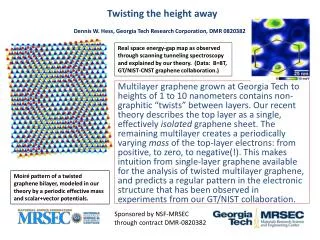
This study, supported by NSF-MRSEC and conducted by Georgia Tech Research Corporation, investigates the energy-gap mapping of multilayer graphene with twist angles of 1 to 10 nanometers. Using scanning tunneling spectroscopy, we explore how these twists impact the electronic structure. Our novel theory describes the top layer as a solitary graphene sheet, with the rest of the multilayer influencing the mass of the top-layer electrons. This insight aids in understanding twisted graphene, predicting observable patterns aligned with experimental findings from the GT/NIST collaboration.

Exploration of Twisted Multilayer Graphene: Energy Gap Mapping and Theoretical Insights
E N D
Presentation Transcript
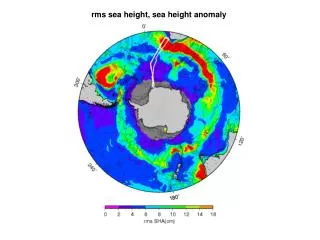
Twisting the height away Dennis W. Hess, Georgia Tech Research Corporation, DMR 0820382 Real space energy-gap map as observed through scanning tunneling spectroscopy and explained by our theory. (Data: B=8T, GT/NIST-CNST graphene collaboration.) Multilayer graphene grown at Georgia Tech to heights of 1 to 10 nanometers contains non-graphitic “twists” between layers. Our recent theory describes the top layer as a single, effectively isolated graphene sheet. The remaining multilayer creates a periodically varying mass of the top-layer electrons: from positive, to zero, to negative(!). This makes intuition from single-layer graphene available for the analysis of twisted multilayer graphene, and predicts a regular pattern in the electronic structure that has been observed in experiments from our GT/NIST collaboration. Moiré pattern of a twisted graphene bilayer, modeled in our theory by a periodic effective mass and scalar+vector potentials. Sponsored by NSF-MRSEC through contract DMR-0820382