SlideServe
Menu
Préférences
© SlideServe · v2026

Analyzing Visual Documents: Interpretation and Contextualization Strategies

hayward avatar
8 diapositives · 207 Views · Feb 11, 2014

A framework for analyzing visual documents by identifying the document type, setting, main characters, appearance, attitudes, and likely actions. It also encourages interpreting contextual clues to predict past events and future actions, helping readers develop insightful analyses of visual materials.
Analyzing Visual Documents: Interpretation and Contextualization Strategies - slide 1
01 / 8Analyzing Visual Documents: Interpretation and Contextualization Strategies
1 / 17

Télécharger la présentation

Analyzing Visual Documents: Interpretation and Contextualization Strategies
Une image / un lien ci-dessous est fourni (tel quel) pour télécharger la présentation

Politique de téléchargement : le contenu du site vous est fourni TEL QUEL pour votre information et votre usage personnel ; il ne peut être vendu, concédé sous licence ni partagé sur d’autres sites sans l’accord de son auteur.Le contenu vous est fourni TEL QUEL, pour votre information et votre usage personnel uniquement. Téléchargez la présentation en cliquant sur ce lien. Lors du téléchargement, si vous ne parvenez pas à télécharger une présentation, l’éditeur a peut-être supprimé le fichier de son serveur.Pendant le téléchargement, si vous ne parvenez pas à obtenir une présentation, le fichier a peut-être été supprimé par l’éditeur.

F I N

Plus de contenu associé

Transcription de la présentation
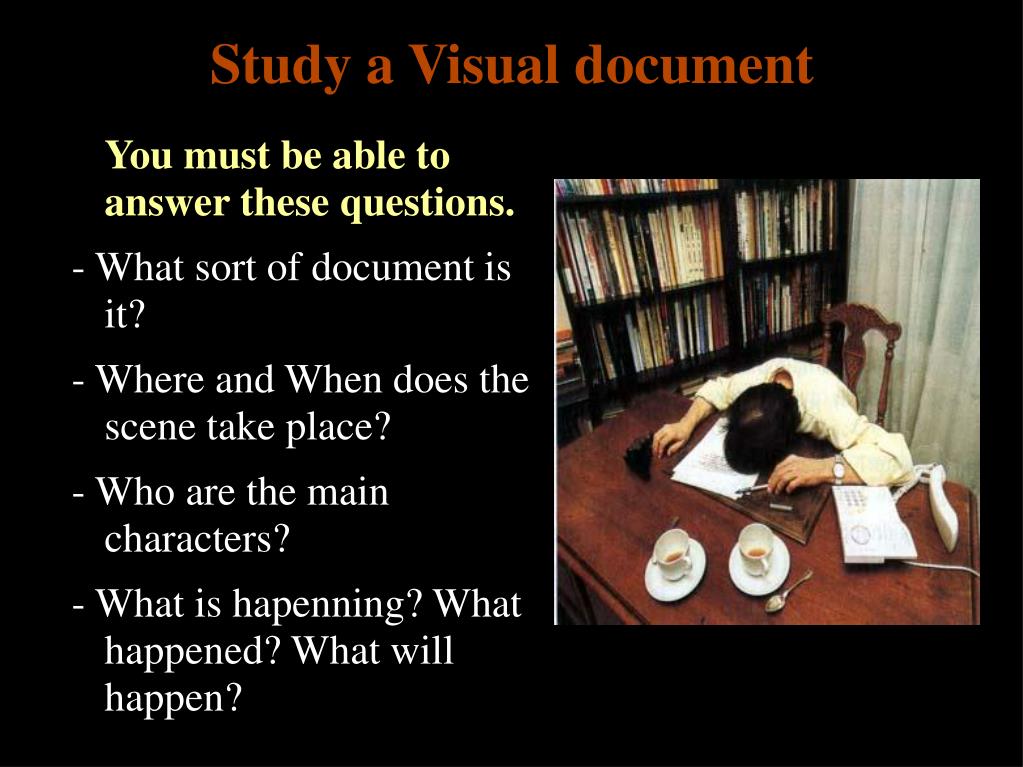
  1. Study a Visual document • You must be able to answer these questions. - What sort of document is it? - Where and When does the scene take place? - Who are the main characters? - What is hapenning? What happened? What will happen?

  2. You must be able to answer these questions. • Answering these questions is part of the description of the document. • But you must also go beyong description and try to interpret the document: - you can express probability to guess what probably happened before, or what will probably happen next, for example.

  3. - What sort of document is it? • Is the document - a photo (graph) (a colour ~ a ~ in black and white) - a cartoon - a drawing - a comic-strip - a poster - an advertisement. ?

  4. Where and When does the scene take place? • Situate the scene precisely (from the more general to the more precise) ►use appropriate time and place prepositions : in, on, at, near, in front of, behind, after, before...

  5. - Who are the main characters? • Make a detailed description of the person or people • - Sex, age, physical appearance, face expression, attitude, social position, probable job...and as many details as possible

  6. What is hapenning? What happened? What will happen? What is hapenning? What happened? What will happen? Express probability when you are not 100% sure • Present actions - • He must- may – can't • BE + V-ing • Past actions • He must-may- can't • Have + V-EN (ppé) • Future actions • He is likely to – he may - he is unlikely to + VB

  7. Now your turn.... • The document is • ............. • The scene takes place • ............. • A man is • ............... • Judging from the gun • near his hand, the man may ..................

  8. Photo from: Wide Open, Seconde, Hachette Education, Paris, 2001, p. 71 Presentation byLaurenceBernard, ac- martinique