Cell Structure
Explore the fascinating world of cells, the fundamental units of life, first discovered in 1665 by Robert Hooke. Learn about the two main types of cells: prokaryotes and eukaryotes, along with unicellular and multicellular organisms. Delve into the cell theory, covering the essential ideas that all living things are composed of cells, the role of organelles, and the functions of various cell components like the nucleus, mitochondria, and ribosomes. Discover the differences between plant and animal cells, their specialized structures, and the advantages of multicellularity, such as differentiation and genetic diversity.

Cell Structure
E N D
Presentation Transcript
Unit 3 Obj. 1.1.1, 1.1.2 Cell Structure
What is a cell? • The basic unit of life • Discovered in 1665 by Robert Hooke • He thought they looked like the rooms monks lived in, so he called them “cells”
Cell History Continued • Anton van Leeuwenhoek used a hand held microscope to look at pond scum and scrapings from his teeth in 1673 • He thought they look like little animals
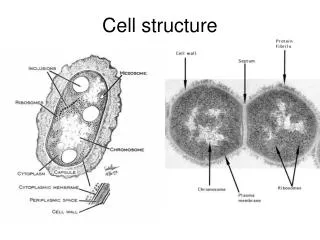
What kinds of cells are there? • Prokaryotes = no nucleus • Example: Bacteria • Eukaryotes = have a nucleus • Example: Animals, plants
What kinds of organisms are there? • Unicellular = made of only one cell • Multicellular = made of two or more cells
Cell Theory • Contributed to by Theodor Schwann and Matthias JakobSchleiden in 1839 and Rudolf Virchow in 1858. • Three main ideas: • 1. All living things are made of cells. • 2. Cells are the basic unit of structure and function in all living things. • 3. New cells come from pre-existing cells.
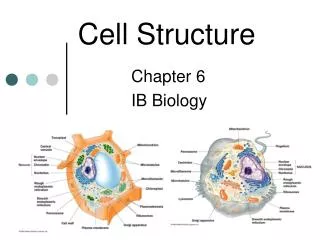
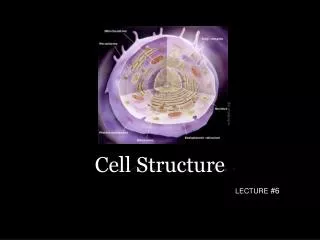
What are organelles? • Organelles are specialized parts of eukaryotic cells that have specific functions within the cells • Make the cell more efficient and complex
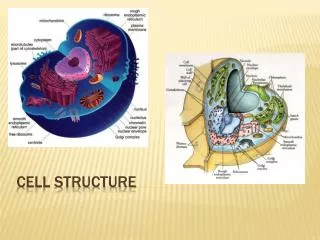
Nucleus • Contains the genes that control the cell = DNA • Chromatin = uncoiled DNA • Chromosomes = coiled DNA • Surrounded by nuclear envelope = double membrane • The “information center” of the cell
Nucleolus • Makes rRNA and assembles ribosomes • Not surrounded by a membrane • Cells can have 1-3 • Disappears when the cell divides
Plasma Membrane • Provides protection • Helps cell communicate • Transports substances in and out of cell • Keeps the cell together • Made of a phospholipidbilayer (phosphate head, lipid tail, two layers) • The head is hydrophilic (loves water), the tails are hydrophobic (fears water) • Selectively permeable
Mitochondria • Where the cell performs respiration makes ATP, a molecule the cell can use as energy for work • Major site of metabolism the more mitochondria per cell you have, the higher your metabolism will be • Folded inner membrane (cristae) more surface area for chemical reactions
Rough endoplasmic reticulum • Rough ER • Called “rough” because it is studded with ribosomes • Makes proteins • The “highway” of the cell transports proteins
Smooth endoplasmic reticulum • Smooth ER • Lacks ribosomes • Makes lipids • Also the “highway” of the cell an interconnected network of tubules and vesicles
Ribosomes • Protein synthesis = making proteins using RNA from the nucleus to assemble amino acids into proteins • Can be floating in cytoplasm or attached to a membrane
Lysosomes • Contain digestive enzymes • Digest food, worn out organelles, viruses, etc. • Can also act as a “self-destruct button” and cause the cell to lyse itself apoptosis • The “janitor,” “hit man,” and “suicide bomber” of the cell
Golgi Apparatus • Processes and packages macromolecules that are synthesized by the cell in vesicles (membrane bound packages) • Secretion • Found in eukaryotes only
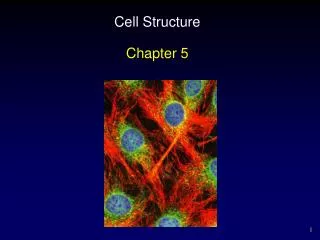
Cytoskeleton • Made of protein – microtubules and microfilaments • “Framework” of cell • Provides structural support
Cytoplasm • Jelly-like substance that helps fill up the cell and suspend organelles • Site of many metabolic reactions
Plasmid • DNA molecule that is separate from and can replicate independently from chromosomal DNA • Usually found in prokaryotes
Flagellum • Tail-like projection from cell • Helps cell move by whipping around in a circle similar to helicopter blade
Cilia • Small, hair-like projections • Used to help cell move and sense environment
Pseudopodia • “False foot” • Temporary projections of eukaryotic cells • Usually found in amoeba • Cells use extension and contraction to move around
Eyespots • Photoreceptive organelle = can sense light • Usually found in unicellular photosynthetic cells, like green algae • Allows the organism to respond to light and swim towards it or away from it
Centriole • Only found in animal cells • Made of microtubules • Help the cell divide
Cell Wall • Only found in plant cells • Shapes and supports the cell • Provides additional protection • Made of cellulose = humans cannot digest
Chloroplast • Found only in plant cells • Contains chlorophyll = pigment that gives plants their green color • Traps sunlight to make glucose (food) • Site of photosynthesis
Vacuole • Stores water, sugar, salts, nutrients, wastes, etc. • Large and central in plant cells • Small or not present in animal cells
To be or not to be… multicellular • What are some advantages? • Differentiation each cell performs a specific task, allowing the organism to be more efficient • More control over internal conditions • Greater motility able to move around and avoid predators and find more food • Genetic diversity greater chance for positive traits • What are some disadvantages? • Harder to reproduce must find a mate first • Need more resources
Cell Differentiation • Different cells have specific jobs and functions • Can only happen in multicellular organisms • Structure determines function • For example: • In humans, muscle cells are extra long and narrow with multiple nuclei. • However, the doughnut-shaped red blood cells lose their nuclei early in their development and contain hemoglobin, which binds to oxygen.
How do cells differentiate? • Start out as stem cells = unspecialized, “blank slate,” can become any cell in the body • Development is usually triggered by hormones cells start to specialize
Cell communication • Cells use multiple methods to communicate • Electrical or chemical signals • Recall: The cell membrane is made of a phospholipidbilayer with hydrophobic and hydrophilic parts. • It is called the fluid mosaic model fluid = hydrophobic inner layer slides around, mosaic = made of different parts, such as proteins and lipids • Studded with transport proteins and receptors so things can pass through
Why is it important for cells to communicate? • Cells can sense changes in environment • Processes can be activated or deactivated • Cells can communicate with other cells
Electrical Signals • Cells are very, very close together • Gap junctions = pores in cell membranes that touch another pore in an adjacent cell membrane • Nerve cells(neurons)= cells that are specialized to send signals through the body in one direction only • Messages can be voluntary or involuntary • 2 main parts of a neuron = axon and dendrite
Chemical Signals • Can be very long distance hormones are special proteins that get released into the bloodstream and travel around the whole body • Must be VERY specific to make sure that the right cell receives the message • Receptor = part of cell that receives the message • Can be very short distance or moderate distance