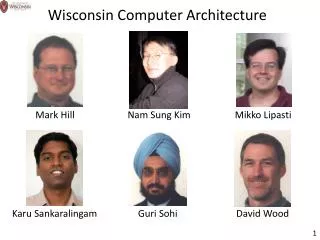
Wisconsin Computer Architecture
Discover the evolution of computer architecture at the University of Wisconsin, highlighting key advancements from the invention of the transistor in 1947 to the modern age of multicore processors. Explore landmark projects and research initiatives such as multithreading, chip multiprocessors, and energy-efficient design tailored for high-performance computing. With a strong history and commitment to innovation, the Wisconsin architecture program fosters a vibrant academic community with notable alumni thriving across academia and industry. Join us in shaping the future of computing!

Wisconsin Computer Architecture
E N D
Presentation Transcript
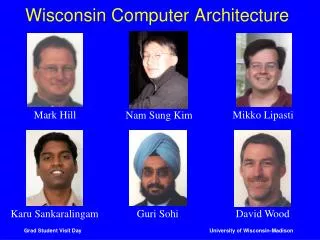
Wisconsin Computer Architecture Mark Hill Mikko Lipasti Karu Sankaralingam Nam Sung Kim Guri Sohi David Wood
Transistor1947 Integrated Circuit 1958 Technology & Moore’s Law 35nm Transistor today Moore’s Law 1964: # Transistors per IC doubles every two years (or 18 months)
Architects & Another Moore’s Law Microprocessor 1971 Intel Nehalem 2010 Popular Moore’s Law: Microprocessor performance doubles every two years
Houston, We Have Problems! • Memory Wall • 1980 Memory Latency ~ 1 instruction • 2008 Memory Latency ~ 1000 instructions • Other Problems • Power & cooling • Reliability • Complexity & test
Chip Multiprocessor (a.k.a Multi-Core) • Replicate • processor “core” & • Caches • Uses more transistors • Tolerates “memory wall” • Simpler lower-power cores • Reduces complexity
an Opportunity---------------- Houston, We Still Have a Problem • Recall Popular Moore’s Law: • Microprocessor performance doubles every two years • Future CMP Performance Doublings Require • Effective multithread programming! • Better communication • Faster synchronization • More cores
Why Computer Architecture at Wisconsin? 1 of 2 • Strong History • processors: branch prediction, decoupled architectures, precise interrupts, out-of-order processors, pipeline clocking, speculative execution, speculative multithreading • memory: snooping coherence, 3Cs model, memory consistency, non-blocking caches, token coherence • simulation: simplescalar, pharmsim, & GEMS • Strong Present • speculative multithreading, speculative coherence, chip multiprocessors, virtual machines, transactional memory • awards: Eckert-Mauchly, Wilkes, IEEE/ACM Fellows, National academy of engineering members • 20 grad students & several well-funded projects
Why Computer Architecture at Wisconsin? 2 of 2 • Former Graduate Students Prospering • Over a dozen in academia: CMU, Duke, Illinois, Maryland, Michigan, NCSU, U Penn, Purdue, Texas, Toronto • Nearly all winners of NSF CAREER awards • 4 winners of Sloan Research Fellowships • Several in key industrial positions: AMD, Cray, IBM, Intel, Sun, others • Includes principal architects of important products (Alpha 21264, Cray T3EX1/) • Strong Future • We average 15-20% ISCA papers since 2000 • Our grads average another 15-20% • We want to add you to this slide!
Selected Projects 1 of 2 • Multifacet: Multicore design (Hill & Wood) • Recent: Log-based Transactional Memory • Future: Deterministic Execution & Replay • Vertical: Technology-driven architecture (Sankaralingam) • Relax: Reliability aware systems • DySER: Energy efficiency through extreme specialization • Multiscalar: Processor Design (Sohi) • Past: Speculative multithreading and variants • Recent/Current: Non-traditional multicore architectures and solving the multicore programming problem.
Selected Projects 2 of 2 • Many-Core Power and Performance(Kim) • Power, performance optimization considering process variability • Reliable, low-power computing • Pharm: System and processor design (Lipasti) • Optimized software & hardware for commercial servers • Novel and power-efficient cache coherence and interconnects • High ILP processors with low power and low complexity