Dynamic Query Optimization and Perspectives
Learn about dynamic programming for query optimization, including subquery size calculations, plan determination, and cost analysis. Explore key lessons and perspectives in database optimization.

Dynamic Query Optimization and Perspectives
E N D
Presentation Transcript
Query Optimization and Perspectives March 12th, 2003
Administration • Exam next Wednesday, 2:30pm. • Special office hours next week will be announced.
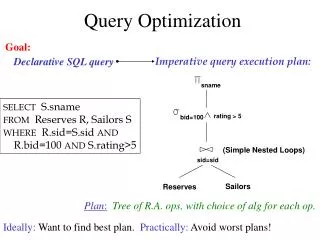
Problem • Given: a query R1 R2 … Rn • Assume we have a function cost() that gives us the cost of every join tree • Find the best join tree for the query
Dynamic Programming • For each subquery Q ⊆ {R1, …, Rn} compute the following: • Size(Q) • A best plan for Q: Plan(Q) • The cost of that plan: Cost(Q)
Dynamic Programming • Step 1: For each {Ri} do: • Size({Ri}) = B(Ri) • Plan({Ri}) = Ri • Cost({Ri}) = (cost of scanning Ri)
Dynamic Programming • Step i: For each Q ⊆ {R1, …, Rn} of cardinality i do: • Compute Size(Q) • For every pair of subqueries Q’, Q’’ s.t. Q = Q’ U Q’’compute cost(Plan(Q’) Plan(Q’’)) • Cost(Q) = the smallest such cost • Plan(Q) = the corresponding plan
Dynamic Programming • Return Plan({R1, …, Rn})
Dynamic Programming • Summary: computes optimal plans for subqueries: • Step 1: {R1}, {R2}, …, {Rn} • Step 2: {R1, R2}, {R1, R3}, …, {Rn-1, Rn} • … • Step n: {R1, …, Rn} • We used naïve size/cost estimations • In practice: • more realistic size/cost estimations • heuristics for Reducing the Search Space • Restrict to left linear trees • Restrict to trees “without cartesian product” • need more than just one plan for each subquery: • “interesting orders”
Plan with Materialization HashTable Srepeat read(R, x) y join(HashTable, x) write(V1, y) HashTable T repeat read(V1, y) z join(HashTable, y) write(V2, z) HashTable Urepeat read(V2, z) u join(HashTable, z) write(Answer, u) ⋈ V2 ⋈ U V1 ⋈ T R S
pipeline Plan with Pipelining ⋈ HashTable1 SHashTable2 T HashTable3 Urepeat read(R, x) y join(HashTable1, x) z join(HashTable2, y) u join(HashTable3, z) write(Answer, u) ⋈ U ⋈ T R S
Key Lessons in Optimization • There are many approaches and many details to consider in query optimization • Classic search/optimization problem! • Not completely solved yet! • Main points to take away are: • Algebraic rules and their use in transformations of queries. • Deciding on join ordering: System-R style (Selinger style) optimization. • Estimating cost of plans and sizes of intermediate results.
The Course in Perspective • The relational data model, SQL • Views, updates, transactions • Conceptual design • Expressing the constraints on the domain • Using them to get good schema designs • XML • A format for data exchange. Has its own query language. • Basis for web services.
Perspective (continued) • Building a database system: • Storage and indexing • Query execution (join algorithms) • Query optimization • Data integration and sharing: • Databases were created independently • Schemas need to be matched • Need to access multiple databases in one query. • Interoperability through web services.