
SlideServe
Menu
Préférences
© SlideServe · v2026

Structure and Function of Macromolecules

helmut avatar
10 diapositives · 338 Views · Feb 13, 2014

Carbohydrates play vital roles in the life of organisms, serving as primary energy sources and structural components. Simple sugars, like glucose, provide immediate energy, while complex carbohydrates such as starch in plants and glycogen in animals function as energy stores. Structural polysaccharides such as cellulose and chitin contribute to cellular structure, with cellulose forming plant cell walls and chitin forming exoskeletons in insects. This chapter explores the classification, functions, and specific types of carbohydrates, highlighting their importance in life processes.
Structure and Function of Macromolecules - slide 1
01 / 10Structure and Function of Macromolecules
1 / 17

Télécharger la présentation

Structure and Function of Macromolecules
Une image / un lien ci-dessous est fourni (tel quel) pour télécharger la présentation

Politique de téléchargement : le contenu du site vous est fourni TEL QUEL pour votre information et votre usage personnel ; il ne peut être vendu, concédé sous licence ni partagé sur d’autres sites sans l’accord de son auteur.Le contenu vous est fourni TEL QUEL, pour votre information et votre usage personnel uniquement. Téléchargez la présentation en cliquant sur ce lien. Lors du téléchargement, si vous ne parvenez pas à télécharger une présentation, l’éditeur a peut-être supprimé le fichier de son serveur.Pendant le téléchargement, si vous ne parvenez pas à obtenir une présentation, le fichier a peut-être été supprimé par l’éditeur.

F I N

Plus de contenu associé

Transcription de la présentation
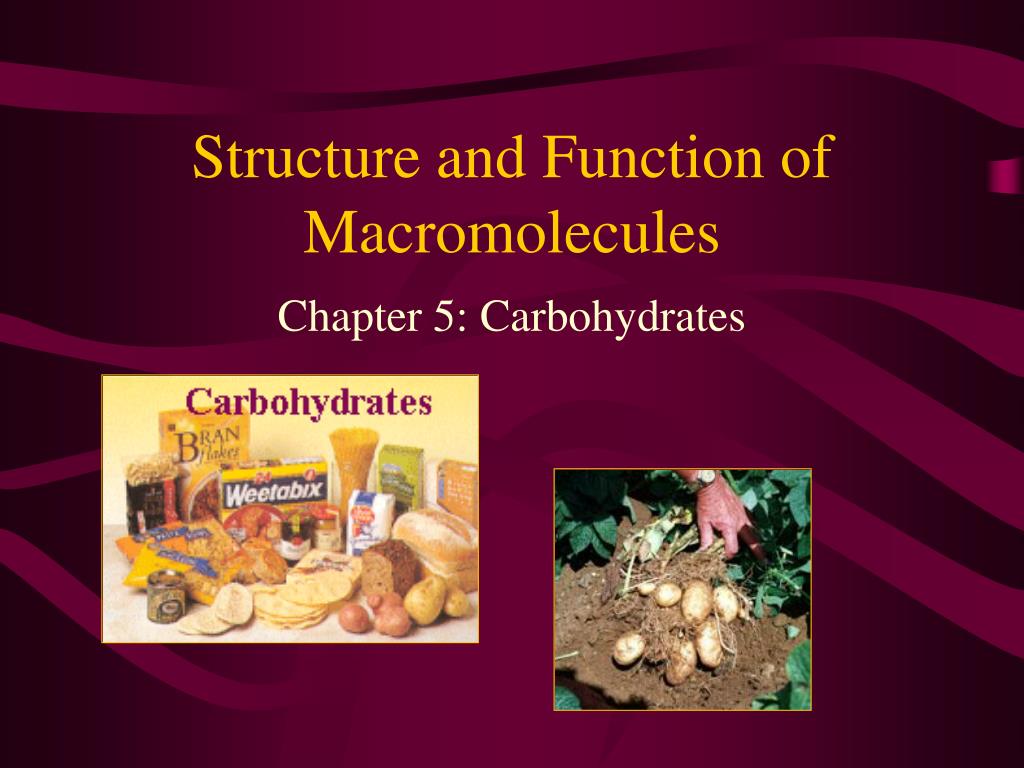
  1. Structure and Function of Macromolecules Chapter 5: Carbohydrates

  2. Carbohydrates function in a number of ways to living things • Simple sugars (glucose) are the primary energy source. • Complex sugar (polysaccharides) have role in storage of energy (starch in plants; glycogen in animals) • Complex sugars also play a role structurally. Ex: Cellulose in plant cell walls, Chitin found in exoskeletons of insects and arthropods.

  3. Simple sugars Complex sugars Monosaccharides Disaccharides Polysaccharides Oligosaccharides Aldoses Ketoses Structural Energy stores Sucrose Lactose Maltose Cellulose & Chitin Glucose Galactose Ribose Deoxyribose Fructose Animals Plants Glycogen Starch Carbohydrates (sugars; CH2O)

  4. Simple sugars: Monosaccharides can be separated into two types; Ketoses and Aldose Can also be classified by length: 3 Carbon =Triose 4 Carbon = Tetrose 5 Carbon = Pentose 6 Carbon = Hexose

  5. Monosaccharides exist in two forms that are in equilibrium

  6. Disaccharides form trough condensation (dehydration) reactions

  7. Polysaccharides may be composed on hundreds of individual monomers, linked in various ways

  8. Two important polysaccharide storage forms of glucose: STARCH and GLYCOGEN

  9. Structural Polysaccharides: Chitin and Cellulose CELLULOSE (plants only)

  10. Chitin • Chitin makes up the hard exoskeleton of insects and arthropods • Also, makes up a dissolvable surgical thread